Can I Get Business Funding With NSFs? Isolated Overdrafts Are Noise.
Isolated NSFs rarely kill cash-flow funding. Clustered overdrafts, empty accounts, and bounced recurring ACH do. Pattern vs count, Quickie's funded-book inversion, which structures still open, and how to clean a tape before you apply.

Key Takeaways
- Isolated NSFs are noise; clustered ones are a verdict. One or two cured overdrafts on an account that otherwise carries a real balance rarely kill a cash-flow file. Five-plus in about 120 days, clustered around the 1st and the 15th, on an account living near zero, say the account cannot absorb another weekly remittance sized to your sales.
- NSF count inverted in Quickie's funded book. Files with four or more NSF or overdraft fees ran 22% troubled — better than files with none (41%) — because a bank that charges those fees lets the merchant run negative rather than silently declining, and those tend to be real operating accounts. Cash cover, not the fee tally, is the predictor. Tables: small business cash-flow benchmarks 2026.
- The real kill is chronic returned recurring ACH. The same small puller bouncing month after month — bookkeeping software in an $8–$40 loop, a returned auto draft — is a different file from a one-off NSF fee. An account that cannot clear small recurring ACH will bounce a weekly remittance the same way.
- Statements beat aggregator feeds. Of 382 declined files with $3,000+ monthly revenue, 156 carried negative days the bank never recorded; 104 had zero real negative days. If a funder cites negatives you know you did not have, ask them to read the ending balances. Method: reading bank statements like an underwriter.
- Cash-flow desks still fund this shape — banks usually do not. A purchase of future receivables in the $1,000–$25,000 band underwrites deposits, cover, and pattern. Bank and SBA doors still lead with FICO. Qualified files only; nothing here is a guarantee. Policy: /legal/disclosures.
Can you get business funding with NSFs? Sometimes. The useful answer is a pattern. A cash-flow desk asks whether the operating account can carry another weekly remittance after rent, suppliers, and the rest of the week's bills. One bounced ACH that cured the next morning is a timing story. A dense recent cluster on an empty account is a capacity story.
This is commercial funding content from Quickie Business Services LLC. Quickie purchases a slice of a small business's future receivables — not a consumer loan, not a bank product. Offers apply to qualified files only. Approval, amount, pricing, and timing are never guaranteed. We do not invent competitor APRs. See /legal/disclosures.
NSF tape shapes that still fund vs shapes that kill
Read this table before you apply anywhere.
| Tape shape | What it usually means | What still funds | What usually dies |
|---|---|---|---|
| 1–2 NSFs or overdrafts, cured, account otherwise carries a real balance | Timing noise — a deposit landed a day late | Revenue-based advance / receivables purchase; invoice factoring; some fintech lines; CDFI / micro on their own clock | Nothing automatic. Bank / SBA may still stall on FICO, not on the two fees |
| Cluster around the 1st and 15th, account living near zero, five-plus NSF/OD fees in ~120 days | Structural cash-flow problem — the account cannot absorb another weekly | Smaller cash-flow tickets only if live cover exists; factoring if invoices are clean | Full-size advances, bank / SBA, most new lines |
| Same small puller bouncing month after month (software $8–$40 loops, returned auto drafts) | Chronic debit bounces — the rail cannot clear small recurring ACH | Almost nothing on ACH. Factoring can still work when the customer underwrites | Cash-flow ACH products, fintech lines that debit the same account |
| Named funder credit landed, then remittances died short of payoff | Stopped-paying a funder — integrity kill, not "historical / paid off" | Nothing honest | Every cash-flow desk that reads the tape |
| Aggregator feed shows weeks of negatives; bank PDFs show $0.00 floors | Feed artifact — missing debits walked the history backward | The file the statements describe, once a desk reads them | A decline based on the feed alone — push back with PDFs |
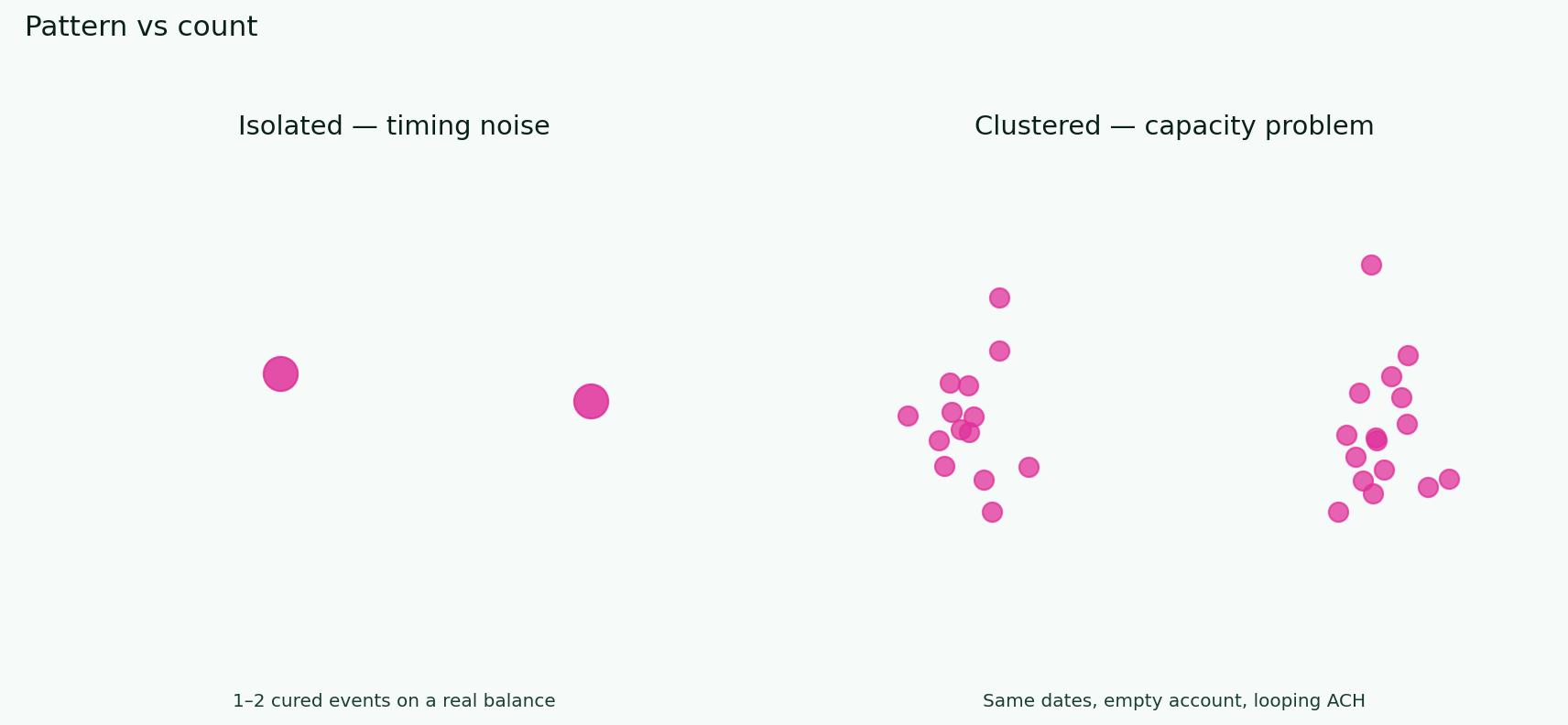
If your shape is the first row, skip to apply. If you are not sure, keep reading.
Can I get business funding with NSFs?
Yes, on a cash-flow desk, when the NSFs are isolated, cured, and sitting on an account that otherwise holds a real balance. No, when they are a dense recent cluster, when the same small debit keeps coming back, or when a named funder already stopped getting paid. Banks and SBA lenders usually never get far enough into the tape to make that distinction — they lead with credit score — so the "NSF decline" you already have is often a product mismatch, not a verdict on the business.
People type same day business funding and emergency business funding when a check bounced last Tuesday. They type business funding with NSF on the phone, not into Ads. The desk that funds $1,000–$25,000 from deposits has to own that objection.
Two clocks still apply. Decision time is underwriting. Money time is ACH rails. Quickie starts with a soft pull (it does not affect FICO the way a hard inquiry does) and can decide in minutes on qualified files. ACH funding for those files often lands same day to the next business day after verification and signing. Nobody honest guarantees the clock. Context: same-day funding reality. How long does it take to get a business loan is those two clocks.
Honest short-cycle uses: an inventory restock, a repair that restores capacity, materials for a signed job, or a short marketing push tied to a sales window. Hubs: working capital funding, fast business funding.
NSF vs overdraft vs returned item — what the tape actually shows
Owners, banks, and funders use these words as if they were interchangeable. They are not.
NSF (non-sufficient funds) fee. The bank declined the item and charged you for the decline. The payee did not get paid. The CFPB's overdraft and NSF explainer and NSF-fee research draw the line: NSF is a declined payment plus a fee; overdraft is a paid payment plus a fee.
Overdraft fee. The bank paid the item, put the account negative, and charged you for the courtesy. The payee got paid. You owe the shortfall plus the fee.
Returned item / ACH return. The payment went out on the ACH network and came back. For a funder, a returned recurring debit is louder than a one-time NSF fee — it is a preview of what a weekly remittance will do on the same rail.
Negative-balance day. Posted balance below zero at some point. It may or may not have produced a fee. Aggregator feeds can show negative days the bank never recorded.
On a funding file: an overdraft fee means the money moved; an NSF fee means the payee is still waiting; a returned recurring debit from the same originator, month after month, means the account cannot clear small scheduled ACH. A weekly remittance is that kind of pull, only bigger. Read who pulled, whether it posted, and whether it came back again — that is how you fund the first row of the table and decline the third. Circle 90–120 days of statements before you apply: reading bank statements like an underwriter.
What operators searching this actually want
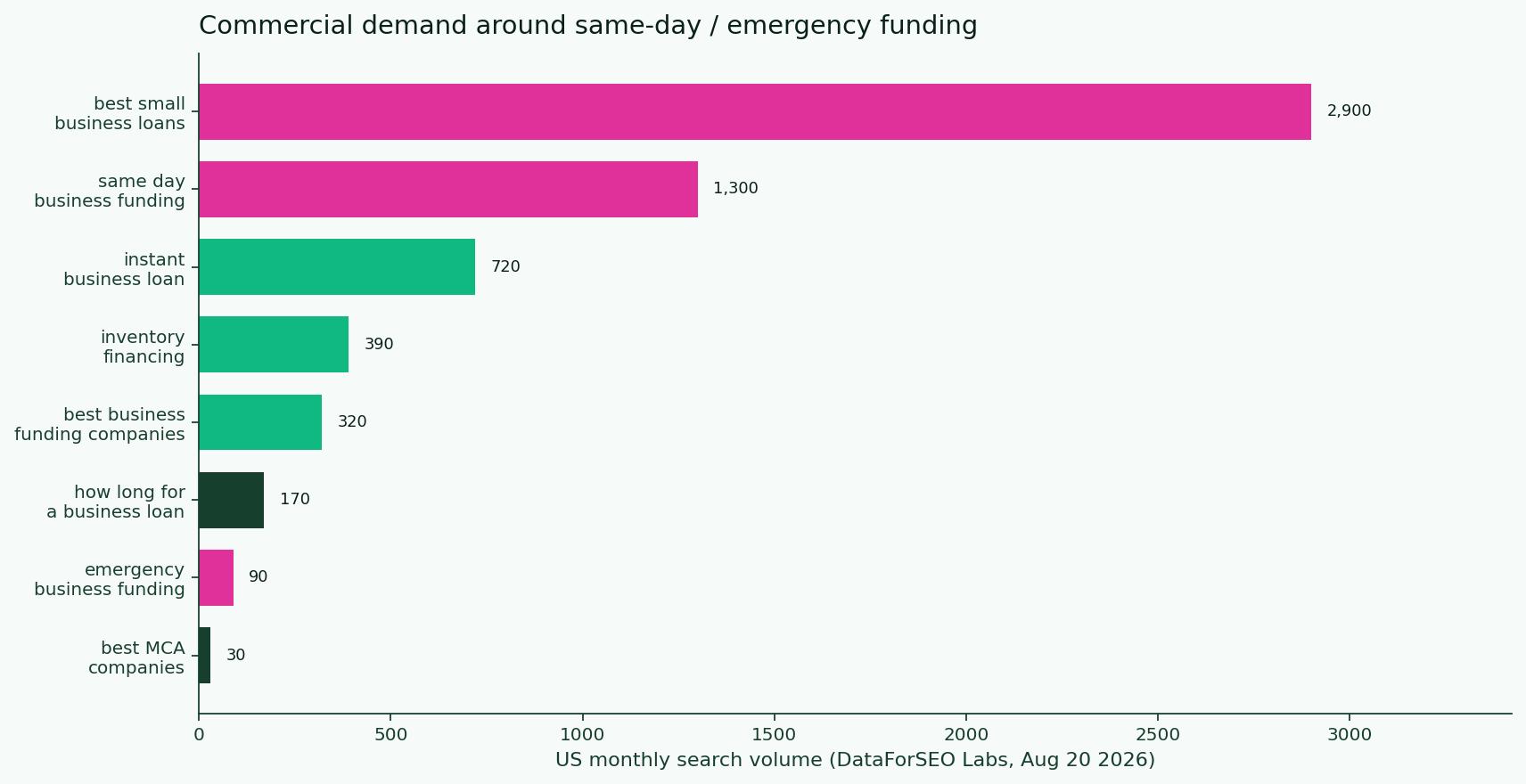
We do not invent search volumes. DataForSEO Labs Keyword Overview, United States, English, August 20, 2026 (live playground pull). A September 9, 2026 refresh was attempted; Google SSO did not attach an API session, so this page reuses the last verified Labs pull and says so once here and again in Sources.
| Keyword | Volume | CPC | KD | Intent |
|---|---|---|---|---|
| best small business loans | 2,900 | 128.93 | 58 | commercial |
| same day business funding | 1,300 | 223.78 | 8 | commercial |
| instant business loan | 720 | 111.88 | 21 | commercial |
| inventory financing | 390 | 101.70 | 0 | commercial |
| best business funding companies | 320 | 150.85 | 29 | commercial |
| how long does it take to get a business loan | 170 | 19.83 | 32 | informational |
| emergency business funding | 90 | 137.20 | 17 | commercial |
| best merchant cash advance companies | 30 | 108.19 | 24 | commercial |
Prior August 2026 head terms, for context: working capital 12,100; business funding 4,400; small business funding 2,900; merchant cash advance 6,600; fast business funding 390.
Pull honesty: NSF-specific long tails — business funding with NSF, NSF business loan, overdraft business funding, can I get a business loan with NSFs — returned no Google Ads volume rows in the August 20 pull. That is the same pattern as other operator-desk phrases. Too sparse for Ads reporting does not mean nobody says them. Those are the words owners use on the phone, so this guide covers each as its own section anyway. We do not invent NSF volumes as "0."
Reading the cluster: same day business funding at 1,300 searches, $223.78 CPC, KD 8 is the tell. Advertisers pay three figures a click for a query the organic SERP barely defends. The person typing often has a tape problem and wants a door that does not start with FICO. Emergency business funding (90 / $137.20 / KD 17) is the same intent, thinner. Instant business loan (720) is the loan-shaped version of the same ask — cash-flow products are not loans. How long does it take to get a business loan (170) is the two-clock question. Comparison terms are where operators go after the first decline.
This page owns the NSF / overdraft objection under those queries. First-row tape: best same-day business funding 2026 and fast business funding. Third- or fourth-row tape: applying faster will not help.
Isolated NSFs: noise at a cash-flow desk
A contractor's operating account usually sits between $2,000 and $6,000. A materials ACH posts at 8:14am; the GC draw hits at 4:02pm; the bank pays from overdraft, charges $35, and the account is whole by dinner. One overdraft line in 90 days. Average daily balance still looks like a business.
That is sequencing, not capacity. Most cash-flow desks treat a handful of NSFs as survivable. They will still size the weekly to the worst stretch of deposits (how much working capital should I take), not treat two cured fees as a character issue.
Isolated means: one or two in the trailing ~120 days; it cured without follow-on fees; the account otherwise carries a real balance; the originator is explainable; it is not the same puller looping.
If that is your tape, you are in the population this product was built for. Quickie funds $1,000–$25,000 as a purchase of future receivables from the deposit tape. Credit is an input — floor 450 FICO under current policy — not the gate. See business funding with bad credit.
Structural NSFs: clustered around the 1st and the 15th
Same contractor, different account. Balance on the 1st is $62. Rent ACH returns. NSF fee. A supplier draft on the 2nd returns. A mid-month insurance pull on the 15th returns. The account never holds more than a couple hundred dollars for more than a day, because every deposit is spoken for before it lands. Five, eight, twelve NSF or overdraft lines in 90–120 days. Negative-balance days stacked around the same calendar.
That pattern says the account cannot absorb another weekly remittance. Adding one does not "smooth" the month. Most cash-flow desks treat a dense recent cluster as a problem because a weekly ACH is one more scheduled claim on an account already losing the 1st and the 15th.
Structural tells: clustered on rent and supplier dates; account living near zero; five-plus NSF or overdraft fees in about 120 days; roughly a week of real negative-balance days; follow-on fees where one NSF breeds three more because the first fee spent the last of the cushion.
The honest move is 30–60 days of letting the cluster age, cutting looping pullers, and applying when the account holds a cushion. New money into this tape is how over-borrowing happens. Files funded at 150% or more of what the math supported ran 46% troubled versus 15% at 80–100%. Empty account plus a stretch: how much working capital should I take.
Why NSF count inverted in a funded book
In Quickie's 2026 funded book — the same study as small business cash-flow benchmarks 2026 — files with four or more NSF or overdraft fees in the window ran 22% troubled, better than files with none (41%). FICO, derogatories, NSF count, and deposit cadence did not separate payers from missers the way the industry's folklore says they should.
The mechanism is not "NSFs are good." It is which banks produce NSF lines at all. A bank that charges those fees lets the merchant run negative rather than silently declining. Those tend to be real operating accounts. A clean-looking feed with zero NSF fees is often a fintech that declined the item with no fee — or an account that is not where the business actually lives. Four fee lines on a $4,000 average daily balance can be a healthy messy operator. Zero fees on a $40 balance can miss the first Friday. Read pattern and cushion, not a cutoff on the fee tally.
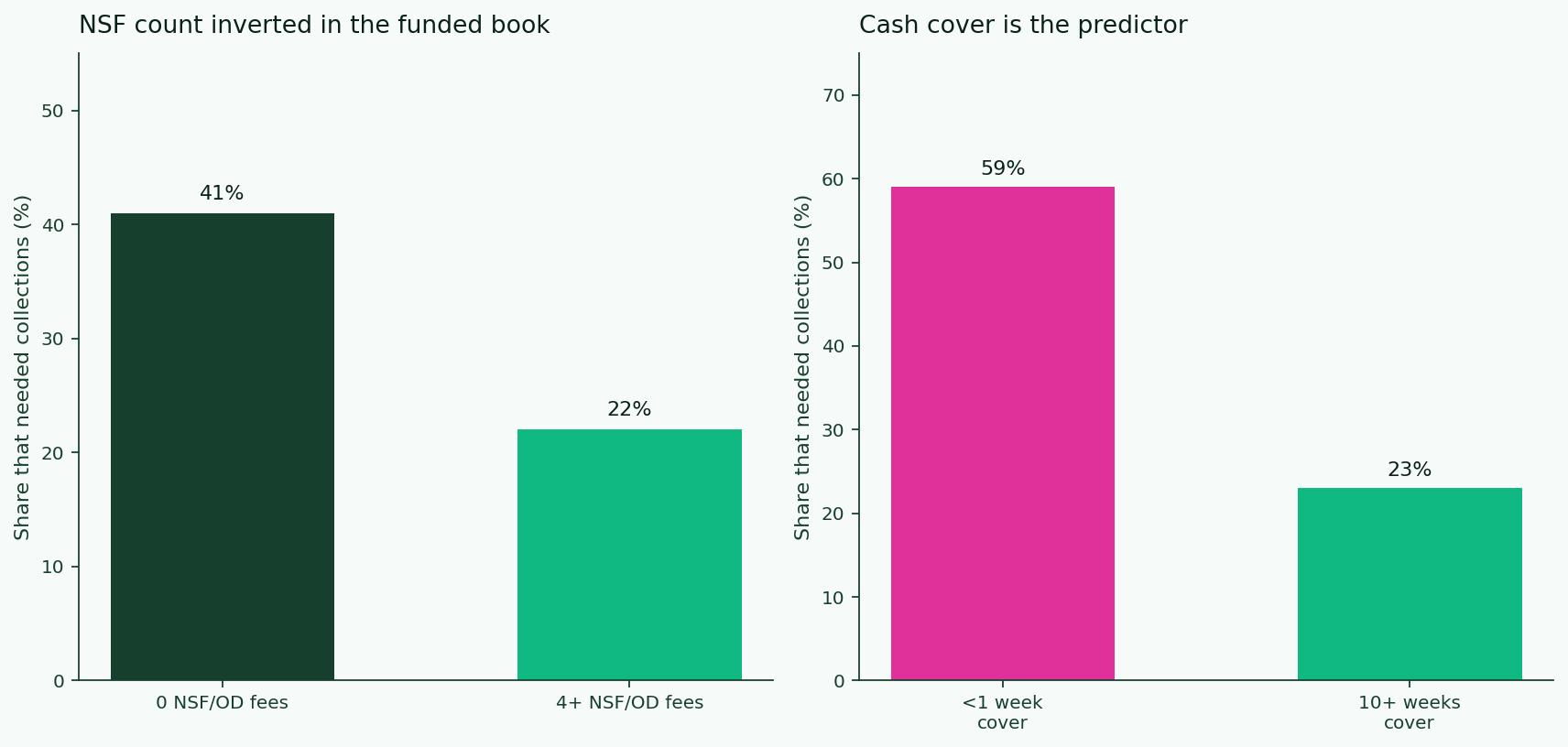
What did separate the book:
- Cash cover. Under 1 week: 59% collections, 23% first-payment default. 10+ weeks: 23% and 4%. Median FICO 554 in both groups.
- Over-borrowing. 150%+ of the supported amount: 46% troubled. 80–100%: 15%.
- A paying stack was not a kill — if remittances were still paying. A named funder that landed a credit then stopped getting paid is an integrity kill (MCA stacking).
- Aggregator negative days predicted almost nothing once you checked statements.
Take cover. Live cash ÷ weekly. Under one week is the cliff. NSF count is a footnote next to that ratio.
Chronic debit bounces: the real kill, not a one-off NSF fee
A one-off NSF fee is a moment. Chronic debit bounces are a system.
The same originator — a bookkeeping platform, a software subscription, an auto lender — drafts $8–$40. It returns. It retries. It returns again, month after month. The account is demonstrating that it cannot clear small recurring ACH. A weekly remittance is the same kind of pull, only bigger. If the $12 bookkeeping draft cannot post, the $180 Friday will not post either. Desks read this as the rail is dead for scheduled debits.
If that is your tape: kill or move the looping originator; stop parking personal auto drafts on the business rail; wait until statements show remaining scheduled drafts clearing; do not apply into the loop. Need money for business: what gets approved is the other list.
Separate stopped-paying a funder from a messy operating account. A named advance that credited the account, then remittances that died short of payoff, is not "I had NSFs." It is a file that took money and quit sending it — a hard no. Paying the stack you already have is the opposite signal (MCA stacking) and usually means a smaller ticket, not a closed door.
Negative days on aggregator feeds are often artifacts
The second way NSF conversations go wrong: the funder is not even looking at your bank.
Most cash-flow underwriters read a balance history from an aggregator's asset report. The aggregator walks backward from today's balance through the transactions it pulled. Every posted debit the feed missed makes every earlier day look poorer — and the deepest "negative" is always the oldest day.
Quickie audited this in 2026. Of 382 declined files with $3,000 or more in monthly revenue, 156 carried negative days the bank never recorded, and 104 had zero real negative days once statement ending balances were checked. Merchants saying "I don't have negative days" were often right. Method: reading bank statements like an underwriter.
Push back on a decline for dozens of negative days without PDFs. A week of real negatives with matching NSF or overdraft fees is the behavior cap, not the artifact. If you are shopping bad-credit options after a decline that cited negatives you did not have, take the PDFs and lead with them.
How many NSFs is too many for business funding?
Owners want a number. Desks will not give a single number that works for every bank, because pattern beats count. Honest bands, in merchant language:
Survivable. One or two NSF or overdraft fees in the trailing ~120 days, cured, on an account that otherwise holds a real balance. Noise.
Watch. Three to five in the window, especially clustering on the 1st and 15th, or thin average daily balance. Expect a haircut or statements — not a ticket sized to your best month.
Problem. More than five NSF or overdraft fees in about 120 days, a dense cluster in the most recent month, or roughly a week of real negative-balance days. Most cash-flow desks treat a handful of NSFs as survivable and a dense recent cluster as a problem. Wait, restack the tape, then apply.
Kill, regardless of tally. The same small puller bouncing month after month. A named funder that stopped getting paid. An aggregator story of negatives the statements contradict — that last one is a kill of the decline once someone reads the PDFs.
Banks and SBA lenders do not use these bands. They use credit score, time in business, and a packet. Two cured NSFs and a 540 FICO is still a no at a 7(a) shop and can still be a yes at a receivables desk. Shop the structure. The Federal Reserve Banks' Small Business Credit Survey has documented for years that approval rates split by channel as credit quality drops. NSF tape is one more reason that split exists.
Credit score vs NSFs: which one actually decides
Both get used as shorthand for "messy." They are not the same input.
Banks and SBA lead with score. A 540 with a gorgeous deposit tape still fails the first screen at most 7(a) shops. If your goal is bank pricing, the work is credit repair plus a packet, on institutional time. The SBA is that door when the file can wait.
Cash-flow desks lead with the tape. In Quickie's funded book the median FICO was 554 in both groups. The 500–549 band actually ran better than the 600–649 band. Credit informed the file; cash cover separated outcomes — under one week 59% / 23%, ten or more weeks 23% / 4%.
Quickie's FICO floor under current policy is 450. Below that, we do not fund. Above it, a 520 with four weeks of cover and two cured overdrafts is a conversation; a 640 with an empty account and a looping $12 return is not. Map: business funding with bad credit. Inquiry type: soft vs hard credit pulls. Quickie starts soft. Do not collect hard pulls while you figure this out — each one is a FICO haircut and a distress signal. Soft-pull cash-flow doors first.
Which funding structures still fund with NSFs
NSFs do not change what the money is. They change which doors still open. Shapes below are category descriptions — not rate quotes. We do not invent competitor pricing.
| Structure | How it treats NSFs | Size fit | Collateral | Speed | Honest fit |
|---|---|---|---|---|---|
| Revenue-based advance (receivables purchase) | Pattern and cover, not a raw fee cutoff | $1,000–$25,000 at Quickie | Owner guaranty, business-asset security interest, UCC-1 | Minutes to decide; same-day to next-business-day ACH for qualified files after verification and signing | Isolated NSFs on a real operating account; restock, repair, materials, marketing push |
| Bank term / SBA 7(a) | Rarely gets to the NSF conversation; FICO first | Often $50K+ when it works | Blanket lien, guaranty | Weeks to months | Strong score and patience — usually no with NSFs and sub-680 credit |
| Fintech line of credit | Often declines a recent NSF cluster or thin ADB | Mid four figures to six figures | Guaranty and/or blanket lien | Days to establish | Revolving need, cleaner recent tape |
| Invoice factoring | Underwrites your customer | Sized to the invoices | Assignment of the receivable | Days to set up | B2B invoices from creditworthy buyers |
| Equipment financing | Asset-driven; NSF tape still on the guaranty | Asset value | Lien on the equipment | Days to weeks | A machine you keep — wrong tool for restock or job materials |
| CDFI / microloan | Character memo | Often under $50K | Varies | Weeks | Operators who can wait |
| Business credit card | Consumer-style; NSF on the linked bank can kill auto-pay | Low four figures | Personal guaranty | Immediate if already open | Small top-offs |

Revenue-based advance / receivables purchase — Quickie's lane. The funder purchases a fixed amount of future receipts at a discount. You receive proceeds now and remit a weekly ACH sized to a percentage of your sales until the purchased amount is delivered. Isolated NSFs on a real operating account are the use case; structural clusters and chronic debit bounces are not. Quickie Business Services LLC funds $1,000–$25,000. Factors commonly ~1.38–1.46 by grade, 1.35 loyalty floor on qualifying renewals, 7.5% origination, standard term often ~18 weeks (stronger files can paper longer). Totals show before you sign; the written offer controls. Agreements include an owner guaranty, a business-asset security interest, and UCC-1 authorization. Full bands: /legal/disclosures. Start at /apply. Qualified files only. Most $1K–$25K inventory restocks use this structure.
Bank and SBA — usually no. A bank loan with NSFs is a no for most small-ticket operators because the same file also fails FICO and packet screens. The SBA is the right long-cycle door when the file can wait — not for a restock that has to ship this week. Do not burn hard inquiries proving that.
Fintech line of credit. Right when the need is revolving (draw, repay, redraw). Many lines live with imperfect credit and still decline a recent NSF cluster. First-row tape: best MCA alternatives 2026. Cluster-row tape: another decline on the same facts.
Invoice factoring. Underwrites your customer, not your NSF count. Open when you bill other businesses or agencies on net-30. Card-and-cash operators do not have invoices to factor.
Equipment financing is the wrong tool. It collateralizes a machine you keep. It will not fund a restock, a marketing push, or job materials. NSF tape still sits on the personal guaranty.
CDFI / micro will take a character memo on committee time. A business card is a top-off, not a capital plan — and auto-pay from an NSF-prone account just moves the bounce onto the card.
Shopping list without invented rates: best business funding companies 2026. Cost: what does business funding cost.
"NSF business loan," "overdraft business funding," and the other phone phrases
These queries returned no Ads rows. They are still how the conversation starts.
"Can I get a business loan with NSFs?" Usually you want a cash-flow product that reads deposits, not a loan. Calling it a loan sets you up for bank declines and the wrong repayment model. Use "business funding," then pick a structure from the table above.
"NSF business loan." Isolated and cured: cash-flow advance or factoring. Clustered: wait. Chronic bounces: do not originate new ACH onto that account.
"Overdraft business funding." Either the owner has been using bank overdraft as a line and wants to replace it, or has overdraft fees and thinks that kills every file. Replacing structural overdraft with a weekly remittance only works if the remittance is smaller than the habit and the account starts holding a cushion. Replacing two cured fees with a restock advance is ordinary.
"Business funding with NSF" is this page. Bring 90–120 days of statements, know whether you are row one or row three, and apply once at a soft-pull desk. Do not shop twenty portals the same afternoon.
Emergency and same-day searches often hide a tape problem
Same day business funding at $223.78 CPC and KD 8 is the most expensive, easiest-to-rank commercial query in this cluster, and the people clicking it often have a bounce in the last ten days. Speed and NSF pattern collide here.
If the tape is isolated NSFs plus a defined use — inventory that turns, a repair that puts a truck back on the road, materials against a signed job, a short ad push with a window — speed is available on qualified files. Decision in minutes; ACH same day to next business day after verification and signing. Honest fast end: same-day funding reality, best same-day business funding 2026.
If the tape is a cluster or chronic debit bounces, speed is a trap — a fast decline, or worse, an approval sized past what the account can carry. The 59% collections rate on under-one-week cover is what the book did when the weekly was already 100% of cash on decision day.
Emergency is a use-of-funds word, not an underwriting word. A compressor that kills a walk-in is a repair that restores capacity — if deposits support the remittance. A request to "cover the week" with no revenue event is a Friday pull on an account that already cannot clear the 1st. Do not fund the second file, fast or slow. Need money for business: what gets approved.
How to clean a bank tape before you apply
You cannot erase posted NSF fees. You can stop adding them. Desks weight recency.
- Read your last three statements. Ending balances, NSF/OD lines, returned ACH, named funder debits. Checklist: reading bank statements like an underwriter.
- Kill looping pullers. Every retry from a $12 subscription is another return.
- Stagger the 1st and the 15th. If rent, insurance, and the main supplier all hit within 48 hours, move what you can.
- Build cover on purpose. Applying because the account is empty is the 59% bucket. Wait for a deposit week.
- Move personal drafts off the business rail.
- Keep paying a named funder or disclose a true payoff. Do not take a second advance to make the first Friday. MCA stacking.
- If the aggregator lied, bring PDFs.
- Apply once, soft-pull, use named — restock, capacity repair, materials for a signed job, marketing push with a window.
Cleanup is 30–60 days of the account looking like it can clear scheduled ACH.
What business funding with NSFs costs
NSFs do not get you a secret discount, and they should not get you a secret markup you cannot see. Cost literacy on short-cycle money is one discipline: convert the offer to total dollars, then compare those dollars to the cash the use will produce, then test the weekly against your worst four weeks of deposits.
On a receivables purchase: amount × factor = total payback; add stated fees; the weekly remittance is the payback spread across the term, sized to a percentage of sales. Quickie bands: factors commonly ~1.38–1.46 by grade, 1.35 loyalty floor on qualifying renewals, 7.5% origination, standard term often ~18 weeks. Origination comes out of the wire — net proceeds are the real number. Totals show before you sign. The written offer controls. Policy: /legal/disclosures. Literacy: what does business funding cost?.
We do not quote competitor APRs. Demand net proceeds and total payback in writing. Two NSF-specific traps: taking more than the tape supports to "make the NSFs stop" (150%+ of supported amount ran 46% troubled); treating a $35 overdraft fee on a $200 shortfall as cheaper than a disclosed factor. If overdraft is your line of credit, price a small disclosed advance against stopping that habit.
How fast funding lands when the tape has NSFs
NSFs change underwriting. They do not change ACH.
- Revenue-based advance: minutes to a decision from bank data on many files (Quickie starts with a soft pull). Isolated NSF files that otherwise qualify still sit on this clock; clustered files sit on a decline clock. For qualified files, ACH funding lands same day to the next business day after verification and signing. No path guarantees timing.
- Fintech line: days to establish if the recent tape is clean enough.
- Factoring / equipment: days to weeks.
- CDFI / bank / SBA: weeks to months.
Apply before midday, connect the bank feed (upload PDFs if the feed is wrong), keep the owner who signs available, and name the use in dollars. Speed cluster: fast business funding, same-day funding reality, best same-day business funding 2026. "Qualified files" is doing real work in every sentence above.
Cash-cycle color by industry (NSFs are not a vertical)
NSF pattern is an account fact, not a restaurant fact. Cover still dominates. In the funded-book study, restaurants, salons, and trucking sat at or below the middle of troubled rates once you controlled for cash — and above four weeks of cover, restaurants in that book essentially did not miss.
Restaurants. Structural NSFs are usually the 1st (rent, food distributor) colliding with a slow Tuesday. Fundable uses: a repair that restores capacity or a documented inventory restock into velocity items. Playbook: restaurant cash-flow.
Construction. Draws land lumpy. Fund materials for a signed job, sized to the draw you can show. Hub: construction contractors. Bridge: contractor net-30.
Ecommerce. Ad spend and inventory leave before payouts settle. Fund a dated restock or a short marketing push, and test the weekly against the post-campaign trough. Hub: ecommerce sellers.
Trucking. A repair that puts a truck back on the road is the cleanest short-cycle use. Read which returns are your operating account failing versus a broker factoring delay. Hub: trucking and logistics.
Industry is color. Cover is the plot.
When not to apply (yet)
Skip or pause when the NSF cluster is still printing; when the same small puller is still retrying; when a named funder credit sat and remittances died; when the use is "catch up" with no restock, capacity repair, signed-job materials, or marketing window; when you cannot hold one week of the remittance without the rest of the week's bills bouncing; when a shop will not show net proceeds and total payback before signature; when you already want more than the deposits support. Longer no: when not to take funding.
How to choose in ten minutes
- Classify the tape from the opening table.
- Feed artifact: PDFs in front of a desk that will read them.
- Chronic bounce or stopped-paying: do not originate new ACH onto that story.
- Cluster: wait 30–60 days; cut looping pullers.
- Isolated: pick the structure — $1K–$25K lump → receivables purchase; revolving → line; invoices → factoring; machine → equipment; packet and time → bank / SBA / CDFI.
- Name the use in dollars and size to worst-four-weeks deposits.
- Compute cover. Live cash ÷ weekly. Under one week is the cliff.
- Soft-pull first. Apply. Read /legal/disclosures.
- Compare total dollars. What it costs. Who is in which lane.
- Take the number the tape can carry.
Sources & methodology
- DataForSEO Labs Keyword Overview (United States, English), live playground pull August 20, 2026 — volume, CPC, and KD in the demand table above; prior August 2026 head-term pulls for working capital (12,100), business funding (4,400), small business funding (2,900), merchant cash advance (6,600), and fast business funding (390). A September 9, 2026 refresh was attempted; Google SSO did not attach an API session, so this page reuses the last verified Labs pull. NSF-specific long tails returned no Google Ads volume rows — too sparse for Ads reporting, not reported as volume 0 — and are covered as sections because that is how owners phrase the question.
- Small Business Administration — working-capital uses and the bank / 7(a) channel this guide contrasts with cash-flow underwriting.
- Federal Reserve Banks, Small Business Credit Survey — credit-access context; approval and product mix by lender channel, especially as credit quality drops.
- Consumer Financial Protection Bureau — NSF vs overdraft (declined item plus fee vs paid item plus fee); companion NSF-fee research note.
- Quickie book study — Small business cash-flow benchmarks 2026: Quickie Business Services LLC funded book (580 files funded late July–September 7, 2026; 468 matured). NSF-count inversion; cash-cover cliff; median FICO 554 in both groups; over-borrowing; aggregator negative-day artifact; paying stack vs stopped-paying. Aggregates only; no merchant identified.
- Quickie policy and disclosures — factor bands, origination, term shape, FICO floor, collateral posture (owner guaranty, business-asset security interest, UCC-1), and "qualified files" language: /legal/disclosures. Policy bands are not a promise for any specific file; the written offer controls.
External references and product facts last verified September 9, 2026. No competitor rates or APRs are estimated anywhere in this guide.
Bottom line
You can get business funding with NSFs when the NSFs are isolated, cured, and sitting on an account that otherwise holds a real balance — and when you pick a desk that underwrites deposits instead of FICO. You cannot paper over a dense recent cluster, a looping $12 return, or a funder you already stopped paying. Count is the wrong screen. Pattern, cover, and whether small recurring ACH actually clears are the right ones.
If your tape is the first row of the table, start an application: soft pull, a decision in minutes for most files, totals before you sign, and same-day to next-business-day ACH for qualified files after verification and signing. Quickie Business Services LLC provides commercial funding via a purchase of future receivables in the $1,000–$25,000 band — not a consumer loan. Approval, amounts, pricing, and timing are never guaranteed. The written offer controls. Read /legal/disclosures. Fund the restock, capacity repair, signed-job materials, or short marketing push the arithmetic supports.
Keep exploring
- Fast business funding
- Working capital funding
- Best same-day business funding 2026
- Best MCA alternatives 2026
- Bad-credit business funding options
- Small business cash-flow benchmarks 2026
- Reading bank statements like an underwriter
- MCA stacking: the quiet killer
- How much working capital should I take?
- Business funding with bad credit
- Same-day funding reality
- What does business funding cost?
- Inventory financing guide
- Need money for business: what gets approved
- Apply
Common questions
Can I get business funding with NSFs?
Often yes on a cash-flow desk when the NSFs are isolated, cured, and sitting on an account that otherwise holds a real balance. Usually no when they are a dense recent cluster, when the same small debit keeps coming back, or when a named funder already stopped getting paid. Banks and SBA lenders typically lead with FICO, so an NSF decline there is often a product mismatch. Quickie purchases future receivables in the $1,000–$25,000 band for qualified files only — approval is never guaranteed.
How many NSFs is too many for business funding?
Pattern beats count. One or two NSF or overdraft fees in about 120 days, cured, on an account with a real balance are usually noise. Three to five, especially clustering on the 1st and 15th, often means a haircut. More than five in about 120 days, or roughly a week of real negative-balance days, is the dense recent cluster most cash-flow desks treat as a problem. The same small puller bouncing month after month is a kill regardless of the fee tally.
What is the difference between an NSF, an overdraft, and a returned item?
An NSF fee is charged when the bank declines a payment because the account is short — the payee is not paid. An overdraft fee is charged when the bank pays the item anyway and puts the account negative. A returned item is an ACH that went out on the network and came back. For a funder, a returned recurring debit from the same originator, month after month, is louder than a one-off NSF fee because a weekly remittance is the same kind of pull.
Do NSFs kill cash-flow funding?
A handful usually does not. In Quickie's 2026 funded book, files with four or more NSF or overdraft fees ran 22% troubled — better than files with none (41%) — because fee-charging banks let merchants run negative rather than silently declining, and those tend to be real operating accounts. Cash cover is the predictor: under one week of cover ran 59% collections and 23% first-payment default; ten or more weeks ran 23% and 4%. Median FICO was 554 in both groups.
How do I clean a bank tape before I apply for funding?
You cannot erase posted NSF fees; you can stop adding them. Kill looping pullers, stagger the 1st and 15th, move personal drafts off the business rail, and wait 30–60 days so recency improves. Build cover on purpose — apply after a deposit week, not because the account is empty. If a named funder is on the tape, keep paying it or disclose a true payoff. If an aggregator showed negatives your statements did not, bring the PDFs.
Does credit score matter more than NSFs for business funding?
At banks and SBA shops, yes — they lead with FICO, so a 540 with a clean tape still fails the first screen. At cash-flow desks, the tape leads. Quickie's funded book had a median FICO of 554 for both clean payers and files that needed collections. Quickie's floor under current policy is 450; above that, cover, NSF pattern, and whether small recurring ACH clears do the work. Checking eligibility at Quickie starts with a soft pull that does not affect FICO the way a hard inquiry does.
How fast can I get business funding if my bank tape has NSFs?
NSFs change underwriting, not ACH. Isolated NSF files that otherwise qualify can still see a decision in minutes from bank data. For qualified files, ACH funding often lands same day to the next business day after verification and signing — never guaranteed. Clustered NSF files and chronic debit bounces sit on a decline clock. Bank, SBA, and CDFI paths still run weeks regardless of NSF count.
What does business funding with NSFs cost?
NSFs do not unlock a secret discount or a hidden markup you cannot see. Convert every offer to total dollars, then test the weekly remittance against your worst four weeks of deposits. On a receivables purchase, amount times factor plus stated fees is the payback; Quickie's published bands are factors commonly about 1.38–1.46 by grade, a 1.35 loyalty floor on qualifying renewals, 7.5% origination, and a standard term often around 18 weeks. The written offer controls. We do not invent competitor APRs.
Published September 9, 2026. Last updated September 9, 2026.
This content is reviewed under Quickie's editorial policy and linked to related legal disclosures where applicable.
Quickie provides commercial financing only. Content is educational and not legal, tax, or accounting advice. Final terms are file-specific and subject to underwriting and verification.