Inventory Financing in 2026: How Operators Fund Restocks Without a Bank Loan
The definitive 2026 operator guide to inventory financing: every restock funding structure compared, the sizing math that decides the buy (margin × turns vs your worst four weeks of deposits), honest speed timelines, and when not to finance stock at all.

Key Takeaways
- Inventory financing is an umbrella, not a product. Dedicated inventory loans collateralize the stock itself; purchase order financing pays your supplier against a confirmed order; a revenue-based advance funds the restock out of future receipts; lines of credit and supplier terms solve smaller, recurring versions of the same gap. Matching the structure to the job matters more than any rate quote.
- A restock decision is a revenue decision. Matching the structure to the job — goods-secured, purchase-order, revenue-based, a line, or supplier terms — matters more than any rate quote.
- Single-pass margin rarely justifies financing on its own. The trade works when shelf capital turns more than once inside the payback term, or when gross margin is fat enough (roughly 50%+) to carry the cost in one pass. The worked examples below show the arithmetic for an $8,000 liquor restock, a $15,000 ecommerce Q4 buy, and a $5,000 salon product wall.
- Size to your worst four weeks of deposits, not your best month. A weekly remittance that fits your slowest stretch survives January; one sized to November does not.
- Collateral posture differs by structure — read what you are granting. An asset-based inventory line pledges and audits the goods. Quickie's structure is a purchase of future receivables ($500–$10,000): the inventory is not separately pledged, but agreements include an owner guaranty, a business-asset security interest, and UCC-1 authorization where applicable — never "no collateral."
- Speed has two clocks. Decisions can land in minutes; money moves on ACH rails. For qualified files, same-day to next-business-day funding after verification and signing is the honest fast end. Banks and asset-based lines run weeks.
- Q4 inventory money is bought in September. Lead times, not sales dates, set the funding calendar — waiting until October usually means air freight or stockouts.
Every restock is the same bet: cash leaves today so revenue can exist later. This guide is the operator version of that bet — every funding structure that covers the gap, the sizing math that actually decides it, how fast each path really lands, and the situations where the right answer is to not finance the buy at all.
This is commercial funding content. Quickie's product is a purchase of future receivables — not a consumer loan. Nothing here guarantees approval, amount, pricing, or funding timing; offers apply to qualified files only. We do not invent competitor rates or APRs anywhere below. See /legal/disclosures.
What is inventory financing?
Inventory financing is capital a business uses to purchase stock before it sells — through a dedicated inventory loan or line secured by the goods, purchase order financing that pays your supplier directly, a revenue-based advance repaid from future sales, a credit line, or extended supplier terms.
That definition is deliberately wide because the phrase is wide. When a wholesale distributor says "inventory financing," they usually mean an asset-based facility where a lender advances against the appraised value of standing stock and sends a field examiner to count it. When a boutique owner or an ecommerce seller types the same phrase into Google at 11pm with a supplier quote open in another tab, they almost always mean something simpler: I need $5,000–$25,000 to place this order before the season, and the bank is not built for that conversation.
Both are real, and they are funded by different instruments. The useful split is between goods-secured structures — the inventory itself is collateral, appraised and monitored — and cash-flow structures — the funder underwrites your deposits and sales history, and the proceeds happen to buy stock. The Small Business Administration lists inventory purchases among the core working-capital uses across its loan programs, and the Federal Reserve Banks' Small Business Credit Survey consistently finds operating expenses — inventory included — among the most-cited reasons employer firms seek financing. In other words: buying stock before it sells is the single most ordinary reason a healthy small business borrows.
One boundary worth drawing immediately: inventory is stock you sell; equipment is what you keep. Lenders paper those completely differently, and confusing them wastes application cycles. More on that below.
The restock trap: why inventory eats cash before it pays you
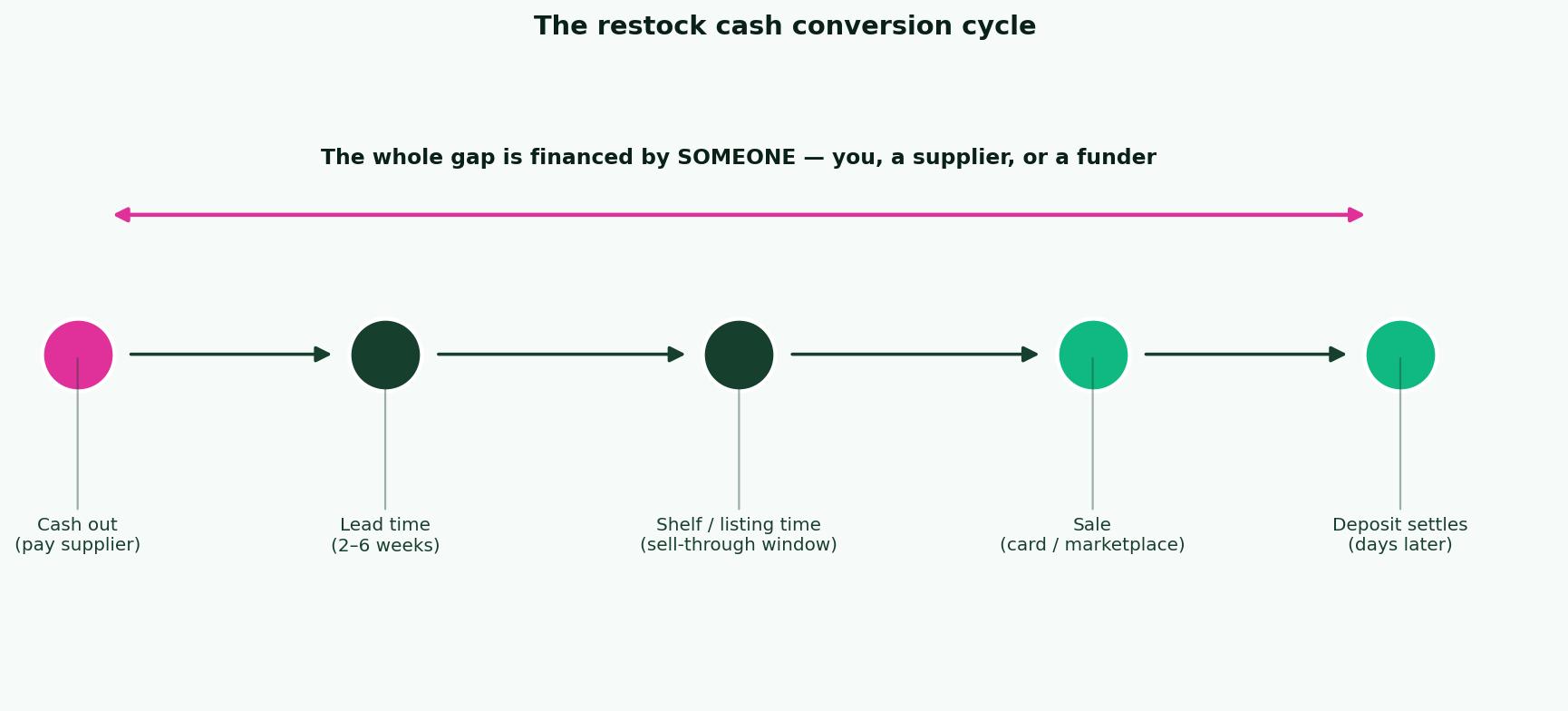
Inventory is the only asset class most small operators buy in bulk, in advance, with cash, on a guess. The gap between paying for stock and getting paid for it has a name — the cash conversion cycle — and it is the entire reason inventory financing exists.
Walk a real example. A boutique wires a distributor $10,000 for a spring order:
- Day 0: cash leaves. The supplier requires prepayment, so days payable outstanding (DPO) is zero.
- Day 14: goods arrive and hit the floor. Lead time is dead time — the money is gone and nothing is sellable yet.
- Days 15–75: the order sells through over roughly 60 days on shelf (days inventory outstanding, DIO ≈ 60).
- Settlement: card processors deposit about two days behind the sale (days sales outstanding, DSO ≈ 2).
Cash conversion cycle = DIO + DSO − DPO = 60 + 2 − 0 = 62 days underwater on the average dollar, with the last units not converting back to cash until day 75 or later. If the distributor granted net-30 terms, DPO of 30 would cut the cycle to 32 days — which is why supplier terms are the first lever, not funders.
Now the part that surprises profitable owners: growth widens the gap. If every reorder is 20% larger than the last, each cycle demands more cash up front than the previous cycle returned. The P&L shows profit; the checking account shows a squeeze that compounds every reorder. This is how a store can post its best quarter ever and still bounce a rent check in the middle of it — and it is why Q4, the most profitable stretch of the retail calendar, is also when the most operators go looking for capital. The Census Bureau's retail inventories-to-sales ratio has hovered near 1.3 in recent releases: as a class, retailers hold more than a month of stock at all times. Somebody finances that month. The only question is whether it is your supplier, your funder, or your own working capital being stretched thin.
Inventory funding structures compared
Six structures cover essentially every way operators fund stock. Shapes below are category descriptions — not rate quotes, and we do not invent competitor pricing.
| Structure | How it works | Typical size fit | Collateral posture | Speed shape | Best for |
|---|---|---|---|---|---|
| Dedicated inventory loan / asset-based line | Lender advances against appraised stock value; goods are the collateral; periodic field exams | Commonly six figures and up | Inventory pledged; blanket lien common | Weeks | Large standing stock; wholesale / distribution |
| Purchase order financing | Funder pays your supplier against a confirmed customer PO; repaid when the end customer pays | Sized to the PO; often $50K+ | Assignment of the PO / receivable | One to three-plus weeks | Long-dated confirmed orders |
| Revenue-based advance (receivables purchase) | Funder purchases a fixed amount of future receipts at a discount; weekly ACH remittance sized to your sales | $500–$10,000 at Quickie | Owner guaranty, business-asset security interest, UCC-1; inventory not separately pledged | Minutes to a decision; same-day to next-business-day funding for qualified files | $500–$10K restocks with a known sales window |
| Business line of credit | Draw, repay, redraw against a set limit | Mid four figures to six figures | Blanket lien and/or guaranty common | Days (fintech) to weeks (bank) | True revolving needs |
| Supplier net terms / trade credit | Supplier ships now; you pay in 30–60 days | Bounded by supplier trust | Often unsecured; sometimes guaranteed | Immediate once granted | The cheapest first dollars of stock |
| Business credit card | Charge the buy; float to the statement | Low four figures | Personal guaranty standard | Immediate with an open card | Small top-offs, not core restocks |

Dedicated inventory loans and asset-based lines
The classic answer to "inventory financing," and still the right one at scale. The lender advances a percentage of the appraised or net-orderly-liquidation value of your stock, files a lien on it, and monitors it — borrowing-base certificates, periodic field exams, sometimes appraisals at your cost. The diligence is why these facilities take weeks to set up and why they only make economic sense at six figures and beyond. If you are importing containers or carrying a warehouse of SKUs, this lane wins and a small advance does not pretend otherwise.
Purchase order financing
PO financing answers a different question: a customer already committed — can someone pay my supplier so I can fill the order? The funder pays the supplier directly against a confirmed purchase order and collects when your end customer pays. It requires a real PO from a creditworthy buyer, fits larger and longer-dated orders, and typically takes one to three-plus weeks of verification. If you are restocking shelves with no signed buyer waiting, PO financing is the wrong tool by definition — there is no PO to finance.
Revenue-based advance / receivables purchase — Quickie's lane
This is the structure most $500–$10K restocks actually use. The funder purchases a fixed amount of your future receivables at a discount; you receive the proceeds now and remit a weekly ACH sized to your sales until the purchased amount is delivered. The underwriting reads your bank deposits, not your shelf: the inventory is never appraised, counted, or separately pledged the way an asset-based line requires. That is not the same as "no collateral" — Quickie agreements include an owner guaranty, a business-asset security interest, and UCC-1 authorization where applicable, and any funder telling you otherwise deserves skepticism. The honest trade: you give up the audit-free simplicity in dollars (factor cost is real, and we show the math below) and you get speed, a soft pull, and a total payback disclosed before you sign. For the fast small-ticket band, see best fast business funding $500–$10K.
Business line of credit
A line is the right instrument when the need is genuinely revolving — many small buys across the year, drawn and repaid repeatedly — rather than one defined restock. Bank lines are the cheapest and slowest; fintech lines (the Fundbox / OnDeck / Bluevine class) establish in days and cost more. If you find yourself wanting to draw, repay, and redraw monthly, a line beats stacking advances, full stop — we say the same thing in best MCA alternatives 2026.
Supplier net terms and trade credit
The cheapest inventory capital is the kind you never buy. Net-30 or net-60 from your distributor is interest-free financing bounded only by your payment history with them, and asking for terms costs one email. The arithmetic cuts both ways, though: when a supplier offers 2/10 net 30 (2% off if paid in 10 days), skipping the discount to keep cash for 20 extra days works out to roughly a 37% annualized cost — plain arithmetic on the generic term structure, not a quote. Sometimes the smartest use of borrowed money is taking the early-pay discount.
Equipment financing is not inventory financing
A common dead end: applying for an "equipment loan" to buy resale stock, or vice versa. Equipment financing collateralizes durable assets you keep — ovens, lifts, machines — usually on multi-year terms roughly matched to useful life. Inventory turns in weeks and no equipment lender wants a lien on goods designed to leave the building. If a lender's paperwork asks for a serial number and your purchase has a sell-by date, you are in the wrong lane.
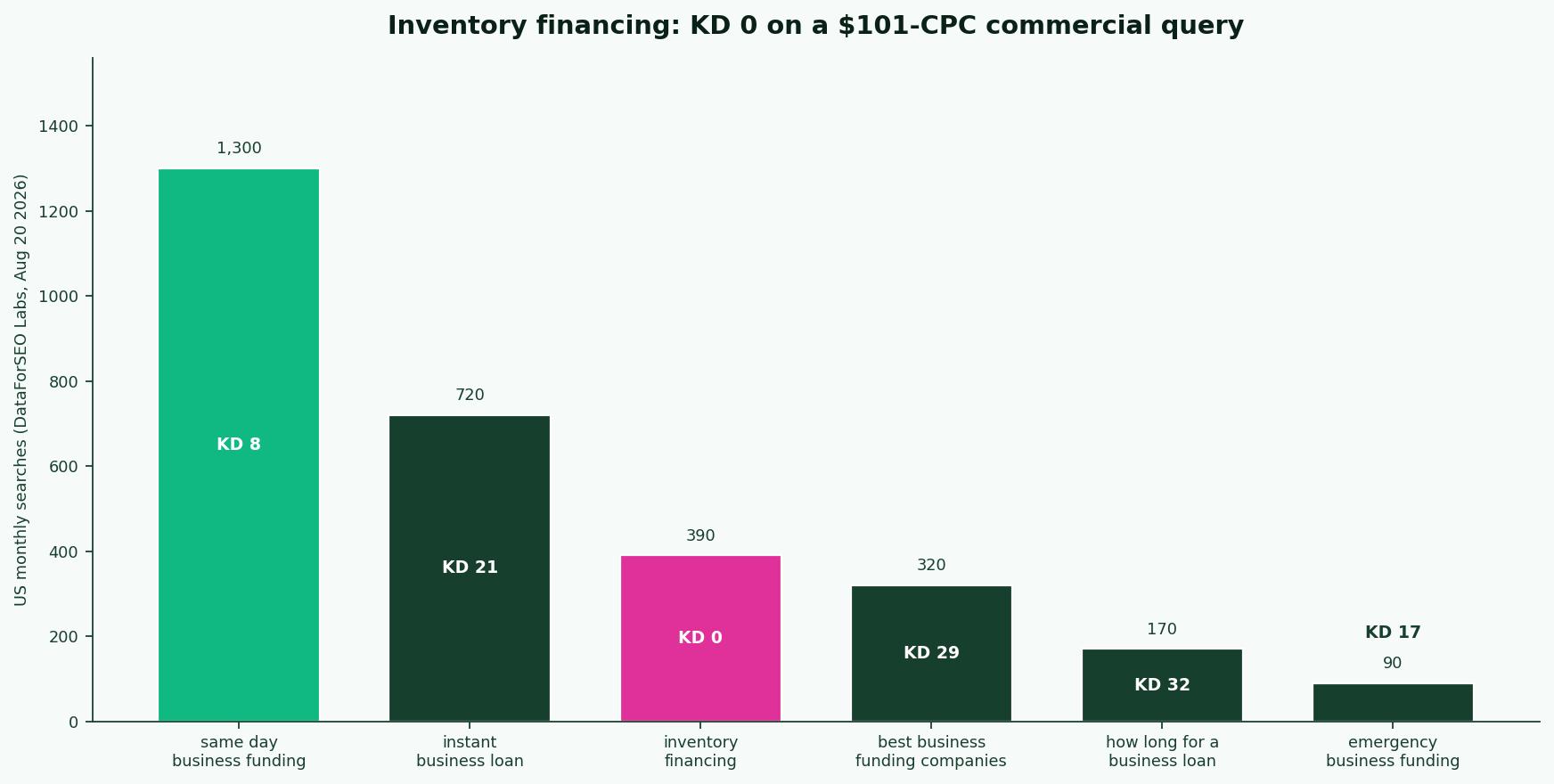
What operators searching "inventory financing" actually want
The person typing this usually has a supplier quote in hand and a season on the calendar. They want four things generic pages do not give: which structure fits their size, the sizing math in real numbers, the speed truth behind "same-day" banners, and permission to not finance a bad buy. That is the outline of everything below. Most inventory searches are also deadline searches — covered in depth at fast business funding. The long-tail phrasings — inventory loans, business loan for inventory, purchase order financing, ecommerce inventory financing — are the same job in different words, so each has its own section.
Restock sizing math: margin, sell-through, and the worst-four-weeks test
This is the section that should decide your restock, and it needs exactly four numbers:
- Restock cost — the landed, all-in number on the supplier quote.
- Gross margin — what the stock returns when it retails.
- Sell-through window — how many weeks until the batch converts to deposits.
- Worst-four-weeks deposits — your four lowest deposit weeks from the last ~90 days, averaged.
Two rules fall out of them. First: financed inventory must either turn more than once inside the payback term, or carry margin fat enough to clear the cost in a single pass. Second: the weekly remittance must fit your worst four weeks, not your best. Everything else is decoration. The dollar figures below use generic factors and terms — not Quickie's pricing, which is based on your sales — purely as illustrations; your written offer controls.
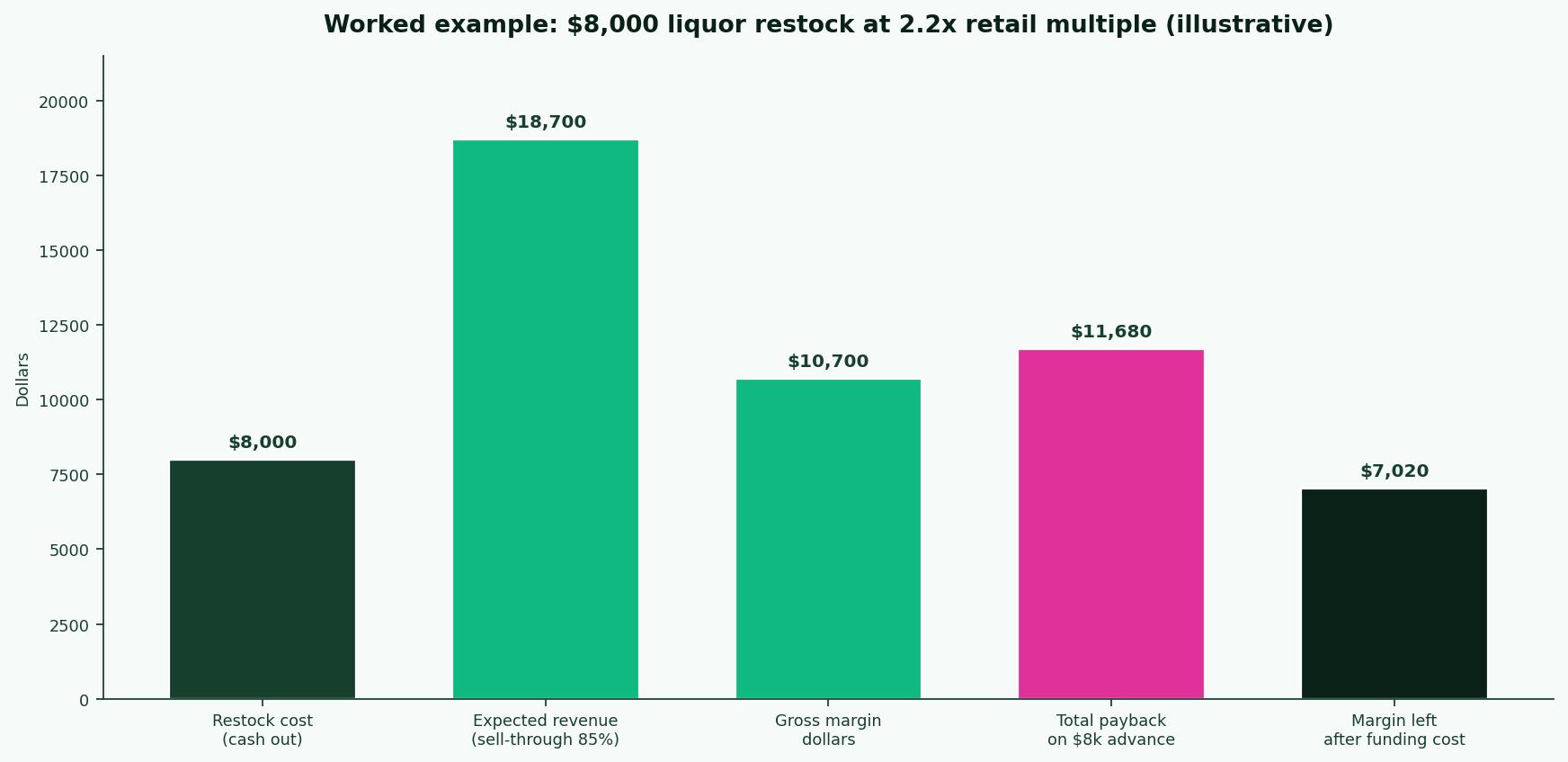
Worked example 1: the $8,000 liquor restock
A liquor store restocks fast-moving spirits and beer at a blended 25% gross margin, selling through in about eight weeks.
- Restock cost: $8,000 → expected retail revenue $8,000 ÷ 0.75 ≈ $10,667 → margin per pass ≈ $2,667
- Illustrative advance: $8,000 × 1.42 factor = $11,360 total payback over 18 weeks ≈ $631/week; 7.5% origination = $600, so about $7,400 net reaches the account — plan the order or the ask around net proceeds
- All-in cost of capital: $3,360 factor cost + $600 origination = $3,960
One pass of margin ($2,667) does not cover $3,960 — and this is the mistake a thinner guide would miss. The trade only works because shelf capital turns: an eight-week sell-through means roughly 2.25 turns inside the 18-week term, so the same $8,000 generates about $6,000 of margin against $3,960 of cost — roughly $2,040 ahead, if every reorder goes back into velocity SKUs. Finance the fast movers; never finance the allocation bottles that sit on the top shelf for a year.
Coverage check: if the store's worst four deposit weeks average $5,400, the $631 remittance is about 11.7% of a bad week — near the top of the comfortable band. If the worst-four average were $4,000, the honest move is a smaller advance, not tighter breathing.
Worked example 2: the $15,000 ecommerce Q4 buy
A DTC brand orders Q4 stock at a 60% gross margin (landed cost is 40% of retail), expecting sell-through across roughly 11 weeks of Q4.
- Restock cost: $15,000 → expected revenue $15,000 ÷ 0.40 = $37,500 → margin $22,500 in a single seasonal pass
- Illustrative advance: $15,000 × 1.40 = $21,000 payback ≈ $1,167/week over 18 weeks; origination $1,125 → about $13,875 net
- All-in cost: $6,000 + $1,125 = $7,125 → margin clears it by roughly $15,375
Fat margin makes this the easiest math in the guide — with one trap. Ad spend competes for the same margin dollars: if it takes $8,000 of paid traffic to move the stock, the batch still nets about $7,375, but the real unit economics are inventory plus acquisition, a pairing we work through in ecommerce working capital: inventory and ad spend. Second trap: an 18-week term funded in mid-September runs into mid-January. November deposits will not be the problem — test the $1,167 against the post-holiday trough, because that is where the remittance will actually live.
Worked example 3: the $5,000 salon product wall
A salon stocks a retail wall at 50% product margin, expecting a slow 14–16 week sell-through as products attach to services.
- Restock cost: $5,000 → expected revenue $10,000 → margin $5,000, one pass inside the term
- Illustrative advance: $5,000 × 1.44 = $7,200 payback = $400/week; origination $375 → about $4,625 net
- All-in cost: $2,200 + $375 = $2,575 → clears by about $2,425 — if the wall sells
The 50% margin carries a single slow pass, which the liquor math could not. The risk is different: product walls are where dead stock is born, because nobody's paycheck depends on selling them. The quiet safety in this file is that the $400 remittance rides on service deposits — the wall is incremental revenue, not the repayment source. That is exactly the shape a deposit-based underwrite likes to see.
The worst-four-weeks test
Pull 90 days of bank deposits. Take the four lowest weeks — including the ugly one you want to explain away — and average them. A weekly remittance around 10–12% of that number is the sanity band a careful desk uses too; past it, one slow stretch turns a good restock into an NSF cascade. Sizing from a strong month is how operators end up over-advanced, a failure mode we dissect in how much working capital should I take? If the worst-four math says $5,000 and the quote says $8,000, order in two waves or split the buy with supplier terms.
By-industry restock playbooks
The math template is universal; the inputs are not. Short versions by vertical, with deeper hub pages linked:
Retail boutiques. Seasonal buys, prepaid distributors, markdown risk on whatever misses. Run an open-to-buy budget so financed dollars chase proven categories, and time advances to order windows rather than sale dates. Full playbook: funding for retail boutiques.
Ecommerce sellers. Longest lead times in small business — overseas production plus transit can run 6–12+ weeks — so the funding date is set by the PO date, not the launch date. Stockouts kill ranking and paid-traffic efficiency, which makes thin inventory expensive in ways the P&L hides. See funding for ecommerce sellers.
Liquor stores. Distributor credit on alcohol is legally restricted in a number of states, so cash-at-delivery is normal and the cash conversion cycle starts at zero DPO. Velocity SKUs justify financing; allocation trophies do not. Holiday case buys commit in early fall. See funding for liquor stores.
Convenience stores. High-frequency, low-margin restocks where tobacco and lottery tie up disproportionate cash. Financing fits cooler resets, and bulk cigarette buys ahead of tax-stamp changes — narrow, dated, provable wins. See funding for convenience stores.
Wholesale distribution. The honest lane split: standing six-figure stock belongs on asset-based facilities; fill-in buys, opportunistic closeouts, and bridging a big receivable fit a Quickie advance up to $10K, or Quickie Prime ($10K–$1M, offers from Quickie and our lending partners) for bigger fills. Both can coexist. See funding for wholesale distribution.
Bakeries and restaurants. "Inventory" here is food cost with a shelf life measured in days, so nobody finances the walk-in. What pencils: case buys ahead of catering contracts and seasonal spikes — short, dated needs matched to booked revenue.
Auto parts. Fat-margin special orders and core-charge float. A counter that can say yes to same-day special orders wins the repair shop's loyalty, and that yes is an inventory-capital decision.
How fast inventory funding actually lands
Every funder advertises speed; almost none separate the two clocks. Decision time is underwriting. Money time is banking rails. Conflating them is how "same-day funding" banners produce Thursday money from a Monday application.
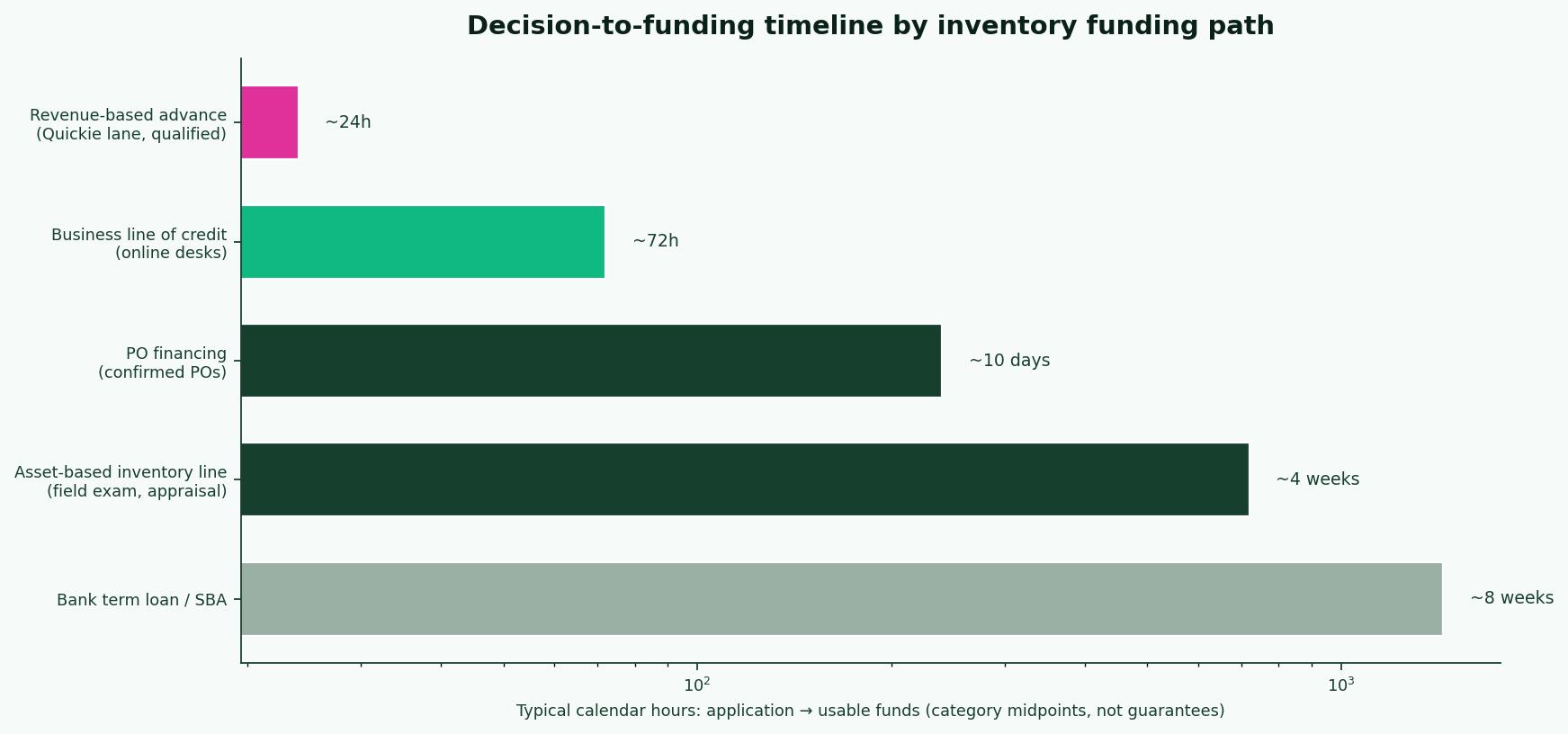
The honest timeline by path:
- Revenue-based advance: minutes to a decision from bank data (Quickie starts with a soft pull). For qualified files, ACH funding lands same day to the next business day after verification and signing. Sign at 4:55pm and the release catches the next window — rails, not marketing.
- Fintech line of credit: often days to establish; draws are fast once the line exists.
- Business credit card / existing supplier terms: immediate, inside their limits.
- Bank line or SBA working-capital loan: typically weeks; cheapest at size, priced in calendar time.
- Asset-based inventory line: weeks, including appraisal and exam scheduling.
- PO financing: one to three-plus weeks of supplier and end-customer verification.
Practical speed tips that actually move the clock: apply before midday, connect the bank feed rather than uploading PDFs, keep the owner who signs available, and have the supplier quote ready so the ask is exact. We stress-test the same-day claim across the industry in same-day funding reality and rank who actually delivers in best same-day business funding 2026; the broader speed lane lives at fast business funding. No path guarantees timing — "qualified files" is doing real work in every sentence above.
What underwriters read on your bank tape before funding a restock
A deposit-based desk decides a restock advance from roughly ninety days of bank activity. Knowing what the tape says before you apply is free:
- Deposit consistency. Weekly cadence beats lumpy totals. Two $20K wires and silence reads riskier than $3,500 landing every week, because a weekly remittance sized to your sales has to live inside that rhythm.
- Average daily balance. The cushion between deposits and a zero balance is what absorbs a slow week. Chronic sub-$500 ADB tells the desk the remittance would be the account's largest standing obligation.
- NSF and negative days — the pattern, not the count. An isolated NSF six weeks back is noise; a cluster in the most recent month is a live cash-flow problem that new stock will not fix. Recent NSFs kill more small-ticket approvals than credit scores do.
- Existing funder load. Other advance remittances already visible on the tape get summed before sizing. Combined pulls crowding your deposit base is exactly the spiral described in MCA stacking: the quiet killer — expect a haircut, not a pretend-it's-invisible approval.
- Story matching. A liquor store claiming eight-week sell-through should show deposits that look like it. When the restock narrative and the tape agree, files move faster.
Read your own last three statements the way the desk will — we wrote the full method in reading bank statements like an underwriter. Fix what is fixable (pause a subscription bleed, time the application after strong deposit weeks, let a recent NSF age), then apply once, cleanly.
Seasonal timing: why Q4 money is bought in September
Inventory funding is bought on the order calendar, and the order calendar runs backwards from the sales window:
Sales window − receiving and shelving − transit − production lead − funding time = the day you need money.
Run it for a Black Friday ecommerce push: sales open late November; domestic receiving needs stock in hand by early November; ocean transit plus overseas production runs 8–12 weeks; suppliers want deposits at PO. The purchase order gets cut in late August or September — which means the funding conversation happens then too, while the "Q4 capital" headlines are still two months from publication. The same backwards math governs liquor holiday allocations (commitments in early fall), Valentine's floral (orders 6–8 weeks out), and garden centers (spring stock booked in winter).
Miss the window and the market charges you one of two penalties: air freight, which can burn most of the margin the financing was supposed to capture, or stockouts, which cost sales plus (for ecommerce) ranking and ad efficiency that take months to rebuild. A third, quieter penalty: applying for capital in a panic week instead of a strong one — worse tape, worse sizing, worse decision, per the underwriting section above.
The calendar rule in one line: decide the order date first; subtract the funding path's honest timeline; that is your application date. A revenue-based advance compresses the last step to days for qualified files, which is precisely why it fits operators who run this math late — but September money is still cheaper than October panic in every currency that matters.
When NOT to finance inventory
The most profitable paragraphs in this guide are the ones that say don't. Four scenarios where financing a restock is the wrong call:
Dead stock. If the current shelf is not selling, financing more of it deepens the loss — capital multiplies a merchandising decision, it cannot fix one. Mark down the dust, free the shelf and the cash, and finance the reorder of what actually moves. A sell-through problem solved with borrowed money becomes a sell-through problem plus a weekly remittance.
Discount-chasing overbuys. A 10% bulk break on stock you did not need is not savings. Saving $800 on an oversized $8,000 order while paying thousands to finance and carry the extra units — plus markdown risk on the tail — is negative arithmetic dressed as a deal. Buy the discount only when the sell-through math from the sizing section clears including the cost of capital.
Stacking to cover a prior advance. If the honest use of new money is making payments on existing money, that is not inventory financing — it is the first step of the spiral we document in MCA stacking: the quiet killer. The tape shows it, desks decline it, and the operators who push through anyway fund their own collapse. Renegotiate or consolidate; do not stack.
Unused supplier terms. If your distributor would grant net-30 for the asking, borrowing first is paying for capital that was available free. Ask for terms, then finance the gap terms cannot cover.
What inventory financing costs (without invented APRs)
Cost literacy on short-cycle money means one discipline: convert everything to total dollars, then compare those dollars to the margin dollars the restock generates. Annualized abstractions on an 18-week instrument mislead in both directions, and competitor pricing shifts too often to quote responsibly — so we do not.
On a receivables purchase the arithmetic is public and short. Amount × factor = total payback; add stated fees; done. At Quickie, pricing and payments are based on your sales, plus a 7.5% origination fee — with net proceeds, total payback, and the weekly ACH shown on the offer screen before you sign. The written offer controls over any summary here, including this one. Worked through the liquor example above (illustrative numbers), the all-in cost sits against roughly $6,000 of turned margin. That is the entire decision, visible before signature — the format every funder should be held to, and the reason we keep pushing operators to demand totals in writing in what does business funding cost?
Two more literacy points. First, net proceeds are the real number: origination comes out of the wire, so a quote that covers the supplier invoice with gross-not-net leaves you short on delivery day. Second, remember the supplier-terms arithmetic from earlier — skipping a 2/10 net-30 discount costs roughly 37% annualized, which means taking that discount with funded money can be one of the few times short-term capital makes a purchase cheaper. Full terms and product disclosures live at /legal/disclosures.
How to choose in ten minutes
- Name the amount honestly. Under $25K → cash-flow structures (advance, card, terms). $25K–$100K → fintech line territory. Six figures → asset-based, PO financing, or SBA.
- Confirmed customer PO in hand? PO financing. No committed buyer? Inventory / working-capital structures.
- Episodic or revolving? One defined restock → fixed advance. Draw-repay-redraw all year → get a line instead.
- Write the four numbers down: restock cost, gross margin, sell-through weeks, worst-four-weeks average deposits.
- Run margin × turns against total capital cost — the sizing section's arithmetic, on your numbers.
- Apply the worst-four-weeks test: weekly remittance ≈ 10–12% of a bad week, maximum.
- Match the clock: money needed in days → advance or existing line. Weeks available → bank paths get cheaper.
- Ask your supplier for terms first. One email; the cheapest capital on this page.
- Read the collateral posture on whatever you sign — lien scope, guaranty, UCC filing. Every legitimate structure has one; "no collateral" marketing is a red flag, not a feature.
- Get totals in writing and compare dollars to margin dollars. If the written offer and the pitch disagree, the offer is the truth. Broader shopping list: best business funding companies 2026.
Sources & methodology
- Small Business Administration — inventory purchase as a recognized working-capital use across SBA loan programs.
- Federal Reserve Banks, Small Business Credit Survey — credit-access context; operating expenses including inventory consistently rank among the most-cited reasons employer firms seek financing.
- U.S. Census Bureau — retail inventories-to-sales ratio (recently near 1.3) for the macro carrying-cost context.
- Quickie policy and disclosures — pricing based on sales, origination, and collateral posture summarized from /legal/disclosures and live offer screens. Policy bands are not a promise for any specific file; the written offer controls.
- External references and product facts last verified August 23, 2026. No competitor rates or APRs are estimated anywhere in this guide.
Bottom line
Inventory financing is not one product — it is a sizing question, then a structure question, then a speed question, in that order. Six-figure standing stock belongs on asset-based facilities that appraise and audit the goods. Confirmed long-dated orders belong with PO financing. Genuinely revolving buys belong on a line. And the $500–$10,000 restock with a known sales window — the buy most operators searching this phrase are actually staring at — fits a revenue-based advance sized by the margin-times-turns math and capped by the worst-four-weeks test.
If that last lane is yours, start an application: soft pull to check eligibility, a decision in minutes for most files, totals on one screen before you sign, and same-day to next-business-day ACH for qualified files after verification and signing. Quickie provides commercial funding via a purchase of future receivables — not a consumer loan; approval, amounts, and timing are never guaranteed, and the written offer controls. Fund the restock the arithmetic supports — and let the arithmetic talk you out of the one it doesn't.
Keep exploring
Common questions
What is inventory financing?
Inventory financing is capital a business uses to purchase stock before it sells. It includes dedicated inventory loans or lines secured by the goods themselves, purchase order financing that pays a supplier directly against a confirmed order, revenue-based advances repaid from future sales, business lines of credit, and extended supplier terms. Small operators typically fund $1,000–$25,000 restocks with cash-flow-based products; six-figure stock positions usually fit asset-based structures.
Can I get inventory financing without pledging the inventory as collateral?
Yes — structure matters. Asset-based inventory loans collateralize the stock itself, with appraisals and field exams. A revenue-based advance such as Quickie's funds a restock through a purchase of future receivables, so the inventory is not separately pledged or audited — but that is not 'no collateral': agreements typically include an owner guaranty, a business-asset security interest, and UCC-1 authorization where applicable. Read the collateral posture on anything you sign.
How fast can I get funding for a restock?
Separate the decision from the money movement. Cash-flow desks like Quickie can decide in minutes from bank data with a soft pull, and ACH funding for qualified files often lands same day to the next business day after verification and signing. Fintech lines commonly take days to establish, banks and asset-based inventory lines usually take weeks, and purchase order financing typically takes one to three-plus weeks. No path guarantees timing.
How much inventory financing can I get?
It scales with the structure. Revenue-based advances are sized from bank deposits — Quickie funds $500–$10,000 based on the deposit tape rather than credit score alone, and for bigger restocks Quickie Prime ($10K–$1M) takes one application and brings back offers from Quickie and its lending partners. Fintech lines commonly run mid four figures to six figures. Asset-based inventory lines and purchase order financing scale into six and seven figures against appraised stock or confirmed orders. Whatever the ceiling, size to what your worst four weeks of deposits can carry, not to the maximum offered.
What credit score do I need for inventory financing?
It depends on the structure. Bank lines and SBA loans lean on credit score and financial statements. Revenue-based advances weight bank deposits, average daily balance, and NSF history more heavily than FICO — Quickie starts with a soft pull that does not affect your score, and imperfect credit can still qualify when deposits support the remittance. Approval is never guaranteed on any path.
What does inventory financing cost?
Convert every offer to total dollars and compare those dollars to the margin the restock will generate. On a receivables purchase, cost is the factor times the amount plus stated fees: At Quickie, pricing and payments are based on your sales, plus a 7.5% origination fee — totals are shown before signing and the written offer controls. Competitor pricing varies too widely to quote responsibly; get their totals in writing.
Is purchase order financing the same as inventory financing?
No. Purchase order financing pays your supplier against a confirmed order from your end customer and is repaid when that customer pays — it requires a real PO from a creditworthy buyer and fits larger, longer-dated orders. Inventory financing more broadly funds stock you plan to sell later without a committed buyer. If you are restocking shelves or an ecommerce catalog with no signed customer order, you want inventory or working-capital structures, not PO financing.
When should I not finance inventory?
Skip financing when the stock is not selling — financing dead inventory deepens the loss; when a bulk discount is the only justification for an overbuy; when new money would really be covering payments on an existing advance, which is stacking, not restocking; and when unused supplier terms are available — net-30 from your distributor is cheaper than any funder. Financing multiplies a good restock decision; it cannot fix a bad one.
Published August 23, 2026. Last updated September 23, 2026.
This content is reviewed under Quickie's editorial policy and linked to related legal disclosures where applicable.
Quickie provides commercial financing only. Content is educational and not legal, tax, or accounting advice. Final terms are file-specific and subject to underwriting and verification.