Soft Credit Pull Business Funding: Shop Without a Hard Inquiry Hit
A soft pull does not move FICO. A hard pull is a small, time-boxed haircut — and business funding does not get the mortgage rate-shopping window. How cash-flow desks quote, what Quickie's funded book showed about credit vs cash cover, and how to shop two or three doors without collecting inquiries.

Key Takeaways
- A soft credit pull does not move FICO. The CFPB's line: a soft inquiry is a review other lenders typically do not see, and it has no effect on your credit score. Self-checks at AnnualCreditReport.com are the same class. Quickie runs a soft pull at application and at funding — it does not hard-pull personal credit to show an offer or to fund it.
- A hard inquiry is a small, time-boxed haircut — and business funding does not get the rate-shopping window. myFICO: typically fewer than five points for most people; on the report up to 24 months; scored about 12 months. The collapse-into-one rule is mortgage, auto, and student loan only. Ask every shop, in writing, whether they hard-pull to quote and whether they hard-pull to fund.
- Applying for business funding only hurts your score if someone hard-pulls you. Filling a form is not the event. Authorization of a hard inquiry is. Cash-flow desks that stay soft let you shop. Banks, SBA packets, and many cards often convert. Three serious quotes beat seven panic applications.
- In Quickie's funded book, FICO was flat and cash cover was not. Same study as small business cash-flow benchmarks 2026: 580 funded / 468 matured. Median FICO 554 in both groups. 500–549 ran 33% troubled; 600–649 ran 46%. Under one week of cover: 59% collections / 23% first-payment default. Ten or more weeks: 23% / 4%. Above 1.5× engine max: 45% troubled.
- This is commercial funding, not a consumer loan. Quickie purchases future receivables in the $1,000–$25,000 band. Remittance is a predictable weekly ACH sized to a percentage of your sales. Agreements carry an owner guaranty, a business-asset security interest, and UCC-1. Qualified files only — never guaranteed. Policy: /legal/disclosures.
Most owners delay working capital because they are protecting a FICO number they already know is imperfect. The real file lives in the operating account: deposits, average daily balance, NSF pattern, live cover, and whether a named funder is still getting paid.
Read this table first.
| Soft inquiry | Hard inquiry | Cash-flow desk (receivables purchase) | Bank / SBA | |
|---|---|---|---|---|
| What it is | Review other lenders typically do not see | Review other lenders do see and FICO can score | Soft pull of FICO as an input; decision is the deposit tape | Packet + FICO-led; often a hard pull once you authorize a credit decision |
| Hits FICO? | No (CFPB) | Typically <5 points for most people (myFICO); scored ~12 months; on the report up to 24 | No, when the desk stays soft through quote and funding (Quickie) | Yes, once they hard-pull — ask in writing |
| Rate-shopping window | N/A | Mortgage / auto / student loan only (14-day older FICO / 45-day newer). Business funding does not get it | Does not apply | Does not apply to this product class |
| When it happens | Pre-qual, your own report check, many cash-flow apps | After you authorize a credit decision | Application and funding at Quickie are both soft | Application, underwriting, or closing — ask before you submit |
| What they underwrite | Score as a snapshot | Score, tradelines, utilization, inquiries | Deposits, ADB, NSF pattern, live cover, stacking — FICO floor is a gate | FICO, time in business, tax returns, collateral package |
| Collateral (if you take the money) | N/A | N/A | Owner guaranty + business-asset security interest + UCC-1. Never "no collateral / no liens" | Often a blanket lien and guaranty |
| Honest speed | Minutes to see a file, when the desk is built for it | Same as the product attached to it | Minutes to a decision on many qualified files; ACH same day to next business day after verification and signing — never guaranteed | Weeks to months |
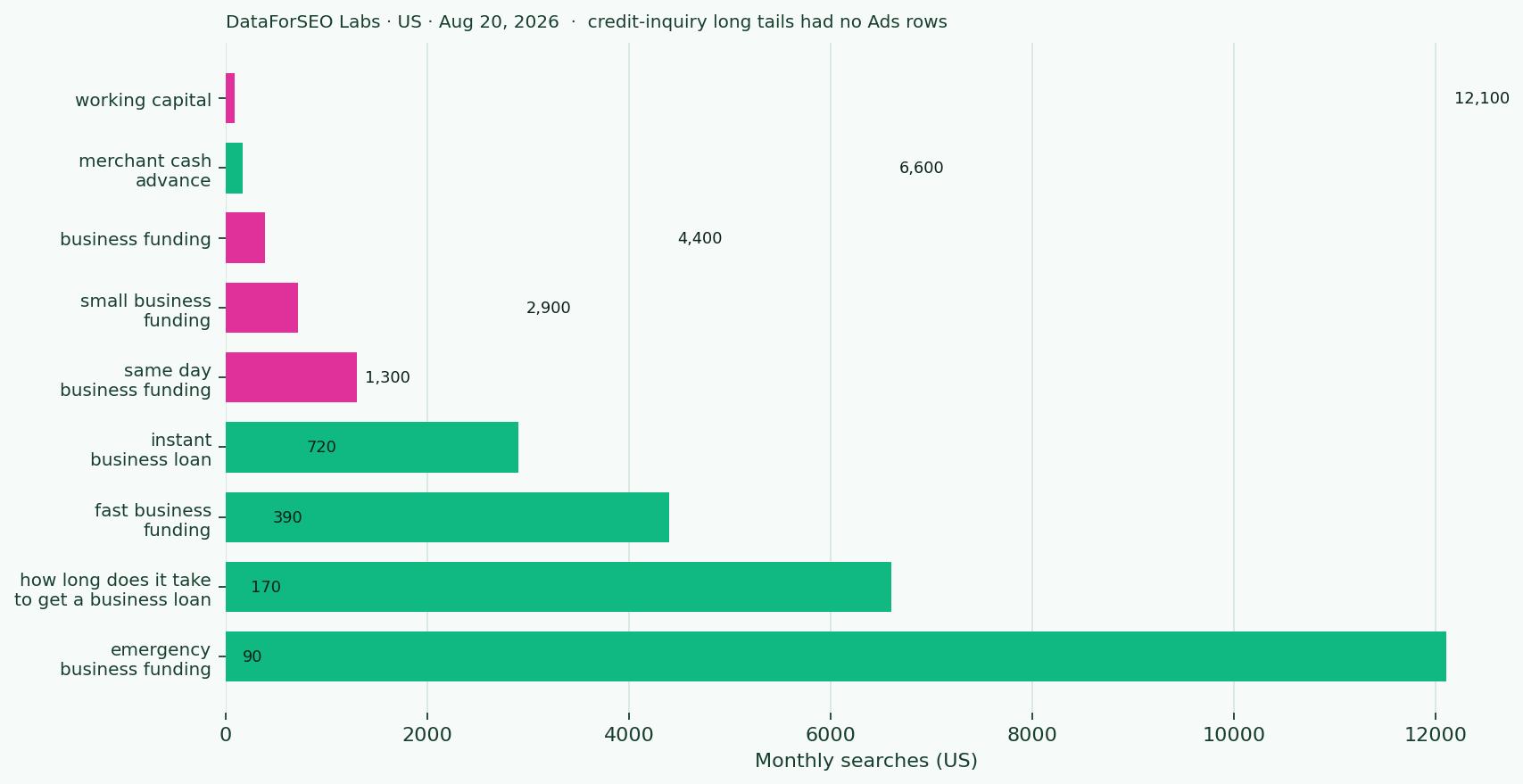
What operators searching this actually want
We do not invent search volumes. DataForSEO Labs Keyword Overview, United States, English, August 20, 2026 (live playground pull). A September 17, 2026 playground login (Google SSO) did not attach an API session, so this page reuses the last verified Labs pull and says so once here and again in Sources.
| Keyword | Volume / mo | CPC | KD | Intent |
|---|---|---|---|---|
| working capital | 12,100 | — | — | commercial / informational |
| merchant cash advance | 6,600 | — | — | commercial |
| business funding | 4,400 | ~$348 | — | commercial |
| small business funding | 2,900 | — | — | commercial |
| same day business funding | 1,300 | $223.78 | 8 | commercial |
| instant business loan | 720 | — | 21 | commercial (loan-shaped) |
| fast business funding | 390 | ~$242 | — | commercial |
| how long does it take to get a business loan | 170 | — | — | informational (two clocks) |
| emergency business funding | 90 | $137.20 | 17 | commercial |
Dashes mean that cell was not in the verified August 20 row set. We do not backfill it.
Pull honesty: credit-inquiry long tails — soft credit pull, does a soft pull affect credit, will applying for a business loan hurt my credit, business funding without hard pull, hard pull vs soft pull — returned no Google Ads volume rows on the last verified Labs pattern. Too sparse for Ads reporting does not mean nobody says them. Those are the words owners use on the phone, so this guide covers each as its own section anyway. We do not invent those volumes as "0."
People pay three-figure CPCs for business funding and same day business funding while the phone objection is "I don't want a hard pull." Instant business loan (720, KD 21) is the loan-shaped version of the same ask — cash-flow products are not loans. Speed hubs: fast business funding and best same-day business funding 2026. If the worry is only FICO, keep reading — then apply once at a desk that stays soft.
What is a soft credit pull for business funding?
A soft credit pull (soft inquiry) is a look at your consumer credit file that does not show up the way a hard inquiry does on the version of the report other lenders use to score you. The CFPB's explainer What is a credit inquiry? (last reviewed September 5, 2025) is the clean split: some inquiries are visible to other companies that pull your report; some are not. Soft is the second class.
The companion page is blunter: What kind of credit inquiry has no effect on my credit score? — soft inquiries. Checking your own report, a company reviewing an account you already have, and many pre-qualification checks sit here.
For an operator, "soft credit pull business funding" means a desk can see your FICO, your tradelines, and whether there is a freeze without using the application as a FICO event. That is how a cash-flow shop decides from the bank feed and still knows whether you clear a floor.
Quickie's posture under current policy: soft pull when you apply, soft pull when we fund. We do not hard-pull personal credit to show an offer or to fund it.
The score still matters as a gate. Quickie's FICO floor under current policy is 450. Below that, we do not fund. Above it, the tape does the work. Map: business funding with bad credit. Shorter companion: soft vs hard credit pulls. Self-check first at AnnualCreditReport.com — that check is yours, not a distress signal.
What a soft pull is not: a promise you will be approved; a substitute for connecting the operating account; "no underwriting"; or "no collateral on the money." If you take a receivables purchase, the paper still has an owner guaranty, a business-asset security interest, and UCC-1 authorization. If a salesperson says "soft pull, no credit check," they are mixing two sentences. There is a credit check. It is the kind that does not score.
Does a soft pull affect your credit score?
No. That is the CFPB's answer, not a marketing line.
Soft inquiries do not enter the FICO scoring model the way hard inquiries do. One soft pull or ten — the score does not move because of those reviews. What can move the file the same week is everything else: maxing a card, missing a personal auto draft, placing or lifting a freeze, or authorizing a hard pull.
A freeze is not a hard pull. If a bureau is frozen, a soft pull can fail to return a usable file. Unfreeze or place a timed thaw, then re-run. Frozen credit is a hold, not a character issue.
What you see vs what they see. You can see soft inquiries on your copy of the report. Other lenders typically cannot. "It showed up when I logged into my own portal" is not the same as "it dinged me."
If the only thing standing between you and a restock is the fear of a soft pull, connect the bank, name the use in dollars, and apply once.
What is a hard credit pull?
A hard credit pull (hard inquiry) is a credit review you authorize in connection with an application for new credit. Other lenders can see it. FICO can score it.
The CFPB's When will a lender run a credit check? is the timing page: a lender generally needs a permissible purpose, and for new credit that purpose is usually your application. The pull is you saying yes.
myFICO's rate-shop explainer is the magnitude page: for most people, a hard inquiry typically costs fewer than five points; it can remain on the report up to 24 months; FICO models consider it for about 12 months; "new credit" is about 10% of a FICO Score.
That is a haircut, not a cliff. It is also not free. Five points on a 720 is a shrug. Five points on a 458 next to a Quickie floor of 450 is a different conversation — which is one more reason not to collect hard pulls while you are still figuring out which structure you want.
A hard pull is the wrong villain in most cash-flow files. The villain is usually an empty operating account, a weekly remittance sized to a banner month, or seven hard-pull applications in nine days because a marketplace sprayed your file.
Hard pulls are the correct tool for some products. A bank term loan and an SBA 7(a) want a full consumer file and a packet. A new business credit card is often a hard inquiry because that is revolving consumer-style credit. The mistake is treating every "business funding" form as if it were that card.
Does applying for business funding hurt your credit score?
Only if the shop hard-pulls you. Applying is not the scoring event. The authorized hard inquiry is.
"Will applying for a business loan hurt my credit?" Three honest answers:
Cash-flow / receivables desk that stays soft. Filling the application should not move FICO. Quickie is in this column: soft at apply, soft at funding. You still get underwritten. You still may be declined. The decline is about the tape or the floor, not about "you checked a box."
Bank, SBA, many credit cards, some fintech lines. The application often is permission to hard-pull. Ask before you submit. If they will not answer in writing, treat it as a hard pull.
Marketplace / broker spray. One form, many buyers. Some soft-pull. Some hard-pull. You do not control the mix unless the marketplace discloses it shop by shop. The rate-shopping window does not save you here.
Loan-shaped language makes this worse. People type instant business loan because that is the Google phrase. A receivables purchase is not a loan. Calling it one sends you to bank packets and card applications — the doors most likely to hard-pull — when the use was an $8,000 restock. Use "business funding," then pick a structure. Comparison without invented rates: Quickie vs MCA, bad-credit business funding options.
If you already applied last week and you are staring at a new inquiry, do not panic-apply to four more shops. Pull your own report (soft). Take one more quote from a desk that will stay soft, and convert offers to total dollars.
Soft pull vs hard pull
This is the comparison owners actually need. The shorter version lives at soft vs hard credit pulls. This table is the operator version.
| Soft pull | Hard pull | |
|---|---|---|
| Other lenders see it on the scored file | Typically no | Yes |
| Effect on FICO | None (CFPB) | Typically <5 points for most people (myFICO) |
| How long it can sit on the report | You may see it on your copy; it is not the scored event | Up to 24 months on the report; FICO scores it ~12 months |
| Rate-shopping collapse | N/A | Mortgage, auto, student loan only |
| Business funding / MCA / cards | Soft is how cash-flow desks quote without a haircut | Each hard pull counts; no special window |
| Self-check (AnnualCreditReport.com) | Soft | Never — that is not how self-checks work |
| Quickie | Application and funding | We do not hard-pull personal credit to quote or to fund |
| What to ask in writing | "Do you soft-pull to quote? Do you hard-pull to fund?" | If either answer is yes, decide whether that door is worth the haircut before you submit |
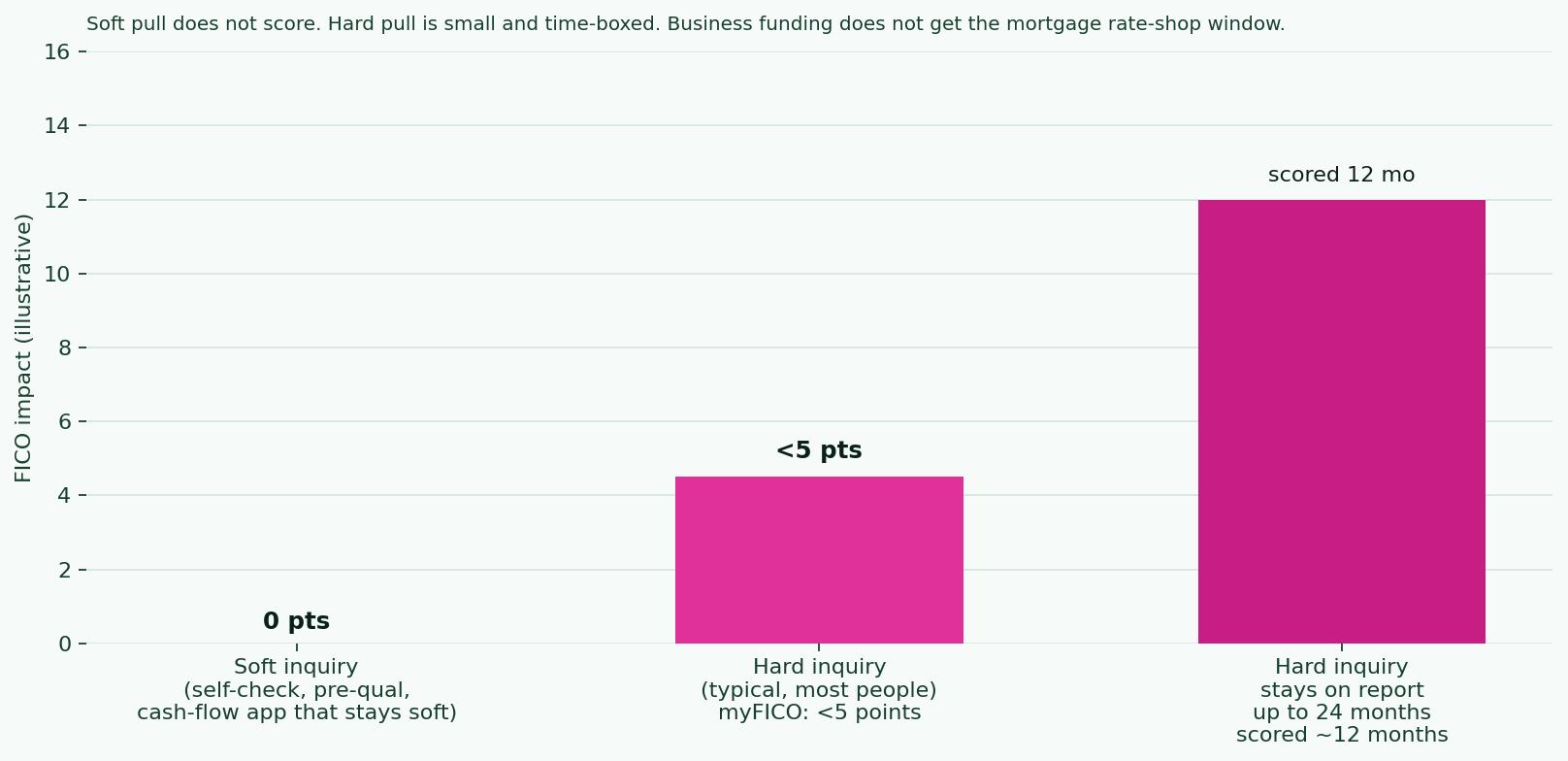
Authorization is the line. Read the checkbox. If it says the pull may be a hard inquiry, that is the whole article. Some shops soft-pull to market a range, then hard-pull when you "lock" — legitimate for a bank, a bait-and-switch if they told you the whole process was soft. Quickie does not convert. Hear conversion before signature, in writing.
Inquiry count is a weak signal on a deposit product. A freeze is not a hard pull — thaw it and re-run. Soft-pull cash-flow and factoring first; save the bank packet for when you actually want bank pricing. The Federal Reserve Banks' Small Business Credit Survey has documented for years that approval rates split by channel as credit quality drops.
Does FICO rate-shopping apply to business funding?
No.
myFICO is explicit: the scoring models give special treatment to rate shopping for a mortgage, an auto loan, or a student loan. Older FICO models use a 14-day window. Newer models use 45 days. Inside that window, several hard inquiries for the same type of loan are treated as one.
That window does not apply to business funding, merchant cash advance / receivables purchase, credit cards, personal loans dressed up as "working capital," or marketplace sprays that hit card issuers and MCA shops in the same afternoon.
If you submit hard-pull applications to seven business funders in a week, you can see seven inquiries. There is no 14-day mercy rule because the use of funds was inventory. Operators hear "rate shopping is safe" from a mortgage article and apply it to a Thursday of broker forms. Different product. Different model treatment.
Decide the structure first. Ask each shop, in writing, soft vs hard at quote and soft vs hard at funding. Take two or three serious quotes in that structure. Convert every quote to net proceeds and total payback (what does business funding cost). If you still want a bank or SBA door, run that as its own project on institutional time.
Quickie does not need the rate-shopping window because we do not hard-pull personal credit to quote or to fund. That is a product choice, not a FICO trick.
What Quickie's funded book says about credit vs cash cover
If you are shopping a soft-pull desk because you think a 540 FICO is the whole file, the book disagrees — in both directions.
The study is public: small business cash-flow benchmarks 2026. Quickie Business Services LLC funded book, 580 files funded late July through September 7, 2026; 468 matured. Aggregates only; no merchant identified.
Credit: median FICO 554 in both the clean group and the troubled group. 500–549 band: 33% troubled. 600–649 band: 46% troubled. A higher personal score did not buy a cleaner remittance book in the band where most of this product lives. The 650+ cells are small; we do not pretend they are a bank-quality sample. Honest sentence: in this product, in this ticket band, FICO did not separate payers from missers.
Cover — live bank balance at decision divided by the weekly remittance: under 1 week ran 59% collections and 23% first-payment default; 10+ weeks ran 23% and 4%. Files funded above 1.5× what the engine supported ran 45% troubled.
A soft pull lets you see an offer without a FICO haircut. It does not make a stretch ticket safe. Size the ask to the use, then test the weekly against the worst four weeks of deposits. Walkthrough: how much working capital should I take.
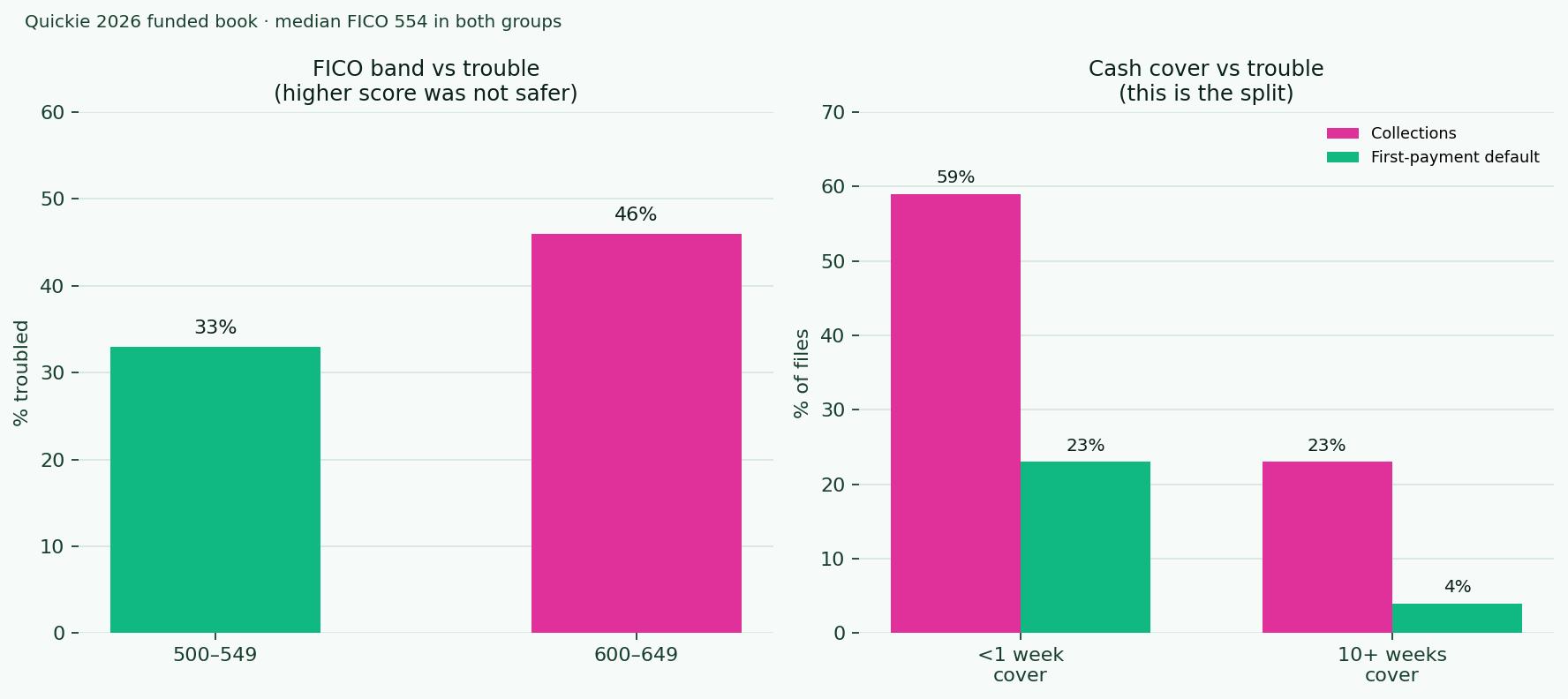
A 520 with four weeks of cover, isolated NSFs, and a named restock is a conversation at a cash-flow desk. A 640 with $40 in the operating account, a looping $12 return, and "cover the week" as the use is not. NSF pattern: business funding with NSFs.
Quickie's floor remains 450. The book is not an argument to ignore credit. It is an argument not to treat the inquiry as the product, and not to treat a 40-point FICO gap as a capacity gap. Banks still lead with score. The SBA is that door when the file can wait. Do not burn hard inquiries proving a restock does not belong there.
Business funding without a hard pull
Yes. That is a real lane. It is not every lane.
Honest versions: a shop soft-pulls personal credit and does not convert at funding (Quickie is built this way); a shop that never touches the consumer file (rare once a personal guaranty is on the paper — ask); invoice factoring that underwrites your customer more than your FICO (still ask what they pull on the owner); a CDFI on committee time (weeks; inquiry type still varies).
It does not mean "no credit check at all," "no personal guaranty," or "no liens." Receivables purchases in this band typically have an owner guaranty, a business-asset security interest, and UCC-1 authorization. Never shop a "no collateral" claim on this product. It also does not mean a guarantee you will be funded. Qualified files only.
If a landing page says "no credit check, no collateral, funded in 15 minutes," walk it to the questions: soft or hard? Convert at funding? Guaranty? UCC-1? Net proceeds and total payback before signature? If they will not answer, you already have the answer.
Start at apply when the use is a short-cycle cash event in the $1,000–$25,000 band and you want the inquiry to stay soft. Read /legal/disclosures before you sign anything — ours or anyone else's.
Which funding structures start soft vs convert to hard
Inquiry type is a feature of the shop, not a law of the structure. The only safe rule is ask in writing before you submit. Shapes below are category descriptions. We do not invent competitor rates or APRs.
| Structure | Typical inquiry (ask anyway) | What they underwrite | Clock / size (category, not a quote) | Honest fit |
|---|---|---|---|---|
| Revenue-based advance / receivables purchase | Often soft to quote; some convert at funding. Quickie: soft both | Deposits, ADB, NSF pattern, cover, stacking; FICO as a floor | $1,000–$25,000 at Quickie; minutes to decide; ACH same day to next business day after verification and signing on qualified files | Restock, capacity repair, signed-job materials, short marketing push |
| Bank term loan | Often hard once you authorize a credit decision | FICO, tax returns, time in business, collateral | Larger tickets when it works; weeks to months | Strong score, patience, a packet |
| SBA 7(a) / similar | Treat as hard unless they say otherwise in writing | FICO, financials, use of proceeds, guaranty stack | Larger, slower | When the file can wait for bank pricing |
| Fintech line of credit | Pre-qual soft, opening often hard | Bank + credit; recent NSF clusters still kill many lines | Days to establish | True revolving need, cleaner recent tape |
| Invoice factoring | Often light on your FICO; they underwrite the buyer — still ask | Invoices, debtor quality | Days; sized to invoices | B2B / net-30 paper |
| Equipment financing | Often hard on the guaranty plus a lien on the machine | Asset + owner credit | Days to weeks | A machine you keep — wrong tool for restock |
| Business credit card | New card: usually hard. Existing card: no new inquiry to swipe | Consumer-style credit | Immediate if already open | Small top-offs, not a capital plan |
| CDFI / microloan | Varies; committee time | Character + packet | Weeks | Operators who can wait |
| Marketplace / broker form | Uncontrolled mix unless disclosed shop by shop | Whatever each buyer does | Fast spray, messy report | Only if you can name every buyer |
Revenue-based advance — Quickie's lane. The funder purchases a fixed amount of future receipts. You receive proceeds now and remit a predictable weekly ACH sized to a percentage of your sales until the purchased amount is delivered. Quickie Business Services LLC funds $1,000–$25,000. Factors commonly ~1.38–1.46 by grade, 1.35 loyalty floor on qualifying renewals, 7.5% origination, standard term often ~18 weeks. Totals show before you sign; the written offer controls. Agreements include an owner guaranty, a business-asset security interest, and UCC-1 authorization. Full bands: /legal/disclosures. Product shape vs daily-holdback MCA folklore: Quickie vs MCA.
The ask-in-writing rule (copy/paste, send before you submit):
Please confirm in writing: (1) do you run a soft inquiry or a hard inquiry to provide a quote? (2) do you run a hard inquiry to fund? (3) if you convert from soft to hard, at what step, and can I decline the offer without a hard pull? (4) please send net proceeds, total payback, remittance amount and schedule, term, and every fee before I sign.
If they will not answer those four, you are not shopping.
Personal FICO vs business credit
Keep this modest. An 80 PAYDEX does not replace a bank feed.
Personal FICO is the consumer score on the owner. Cash-flow desks in this ticket band still pull it — softly, if they are built that way — because the owner is on a guaranty. Quickie's floor is 450. Above the floor, the funded book says cover dominates. Banks treat FICO as the first screen.
Business credit is a different file. Dun & Bradstreet PAYDEX-style scores, if they exist, reflect how the business pays reported vendors — many micro operators have a thin or empty D&B file, and that is normal. Experian Business tracks entity-level tradelines when suppliers report them (same thin-file problem under ~$25k tickets). PayNet-originated commercial payment data (now in the Equifax commercial world) shows up more often on larger commercial and equipment files than on a $1,500 receivables purchase. Do not expect a cash-flow desk to "use PayNet instead of FICO."
What builds a business file, slowly: paying net-30 vendors who report, keeping the entity in good standing, and remitting to funders you already have. What does not: five hard pulls on the owner's Social Security number. A gorgeous D&B file with an empty operating account still misses Friday.
If a shop leads with "we'll build your business credit" as the reason to take expensive short-cycle money, ask how, which bureau, and whether the product is even reported. Then convert the offer to total dollars anyway. A person-titled operating account with business deposits is common in this band: soft pull reads the owner's FICO; the bank feed reads the business. Bad-credit map: business funding with bad credit and bad-credit options.
How to shop without collecting hard inquiries
The 3-quote rule. Not seven.
- Self-check first (soft). AnnualCreditReport.com. Confirm the name, freeze status, and hard inquiries you already have. If you are at 452, a vanity hard pull at a card issuer is how you walk into a 450 floor the wrong way.
- Name the use in dollars. Restock $8,400. Compressor $3,200. Materials for a signed job $6,000. Sizing: how much working capital should I take. Hub: working capital funding.
- Read 90–120 days of the operating account: deposits, worst four weeks, NSF/OD lines, returned ACH, named funder debits, live balance. NSF pattern: business funding with NSFs.
- Pick the structure from the table above. Do not send the same file to a 7(a) shop and an MCA broker on the same afternoon.
- Ask before you submit. Soft vs hard at quote. Soft vs hard at funding. Convert or not. The four-question script above.
- Two or three quotes in one structure. Fourteen marketplace tiles is a spray. Do not "just apply to see" if seeing requires a hard pull.
- Convert to total dollars. Net proceeds, total payback, weekly remittance, term, every fee. What does business funding cost.
- Test the weekly against the worst four weeks, then compute cover: live cash ÷ weekly. Take the number the tape can carry. The 1.5× stretch ran 45% troubled.
Do not let a broker paste your file into a blast list. Do not sign a hard-pull authorization because the button said "see my offers."
A clean week: self-check (soft), read the statements, send the four-question script, apply once at the desk that stays soft, and sign only if totals and cover work.
What a cash-flow desk actually underwrites instead of inquiry count
Inquiry type gets you in the door without a haircut. It is not the underwrite.
A receivables desk in this band is trying to answer one question: can this operating account carry another weekly remittance sized to a percentage of sales, after rent, suppliers, payroll, and the funders already on the tape?
Deposits / real revenue. Money in from customers, platforms, GCs, Zelle from other people — not owner self-sweeps. Size to the business money.
Average daily balance. What the account typically holds. An account that lives at $40 is telling you the first Friday's math.
NSF pattern, not NSF count. Isolated, cured fees are noise. A dense cluster around the 1st and the 15th is capacity. The same small puller bouncing month after month is the rail. Guide: business funding with NSFs. In the funded book, NSF count even inverted — four or more fees ran better than none — because fee-charging banks tend to be real operating accounts.
Live cash cover. Balance at decision ÷ weekly. Under one week: 59% / 23%. Ten or more weeks: 23% / 4%. Apply after a deposit hits.
Stacking. A paying funder is load to size around. A named advance that credited the account and then remittances that died is an integrity kill.
Identity and the floor. Soft-pull FICO, freeze, name match, OFAC. Floor 450. Frozen file: lift it.
Use of funds. Inventory that turns, a repair that restores capacity, materials against a signed job, a dated marketing push. "Catch up" with no revenue event is how over-borrowing starts.
Inquiry count is barely on that list. Longer data: small business cash-flow benchmarks 2026. Imperfect credit as a posture: business funding with bad credit.
How fast: two clocks (decision vs ACH)
How long does it take to get a business loan is two clocks wearing one search query. Soft pull sits on clock one. Money sits on clock two. Honest depth: same-day funding reality. Hubs: fast business funding, best same-day business funding 2026.
Clock 1 — decision. Underwriting. On a cash-flow desk with a live bank connection, a soft pull can return in minutes, and a qualified file can see a decision on that same clock. Frozen credit, a mismatch, a dense NSF cluster, a stopped-paying funder, or a use that is just "cover the week" sit on a slower clock — or a no. Minutes is a qualified-file sentence, not a guarantee.
Clock 2 — money. ACH. After verification and signing, funding for qualified files often lands same day to the next business day. Cutoffs are real. Nobody honest guarantees the clock. "Instant business loan" as advertising is usually clock 1 wearing clock 2's clothes.
Soft pull does not make ACH faster. It removes a reason to delay starting. Apply before midday, connect the real operating account, keep the signer available, name the use in dollars, and do not have a freeze sitting on the bureau. Bank / SBA / CDFI clocks are still weeks.
Emergency searches (emergency business funding, 90 / mo, $137.20 CPC, KD 17) often hide a tape problem. If deposits support the remittance, speed is available on qualified files. If the account already cannot clear the 1st, a fast soft pull just gets you a fast no.
What a soft-pull offer actually costs
Inquiry type does not change the arithmetic. A cheap inquiry attached to an expensive stretch ticket is still an expensive stretch ticket.
Convert every offer to total dollars, then compare those dollars to the cash the use will produce, then test the weekly remittance against your worst four weeks of deposits.
On a receivables purchase:
- Amount × factor = total payback
- Add stated fees
- Origination usually comes out of the wire — net proceeds are the number that lands
- The weekly remittance is the payback spread across the term, sized to a percentage of sales
Quickie bands under current policy: factors commonly ~1.38–1.46 by grade, 1.35 loyalty floor on qualifying renewals, 7.5% origination, standard term often ~18 weeks. Totals show before you sign. The written offer controls. Policy: /legal/disclosures. Full literacy: what does business funding cost.
Worked example (illustrative bands, not a quote, not a promise). $8,000 at a 1.42 factor is $11,360 of purchased receipts. 7.5% origination on $8,000 is $600, so net proceeds are $7,400 if origination is taken from the wire. The weekly remittance is the payback divided by the term the offer actually prints — the offer screen is the source of truth. Test that weekly against the four weakest deposit weeks in the last 90 days. If live cash covers four weeklies on funding day, the file is in the part of the book that behaved. If the weekly is most of a slow week and the account is showing $51, you are in the 59% bucket regardless of whether the pull was soft.
We do not quote competitor APRs. Demand net proceeds and total payback in writing from every shop, including us. Two traps: stretching a cash-flow ticket because a hard-pull bank was slow, and treating "they only soft-pulled" as a discount. It is not a discount. It is the absence of a FICO haircut. Price the money.
When not to apply yet
Pause when they will not say whether the pull is hard; when you need a freeze lifted; when the use is "catch up" with no restock, capacity repair, signed-job materials, or marketing window; when you cannot hold a week of the remittance; when a named funder credited the account and remittances died; or when you already want more than the deposits support (the 45% bucket). Longer no list: when not to take funding.
Sources & methodology
- DataForSEO Labs Keyword Overview (United States, English), live playground pull August 20, 2026 — volume, CPC, and KD in the demand table above. A September 17, 2026 playground login (Google SSO) did not attach an API session, so this page reuses the last verified Labs pull. Credit-inquiry long tails (soft credit pull, does a soft pull affect credit, will applying for a business loan hurt my credit, business funding without hard pull, hard pull vs soft pull) returned no Google Ads volume rows — too sparse for Ads reporting, not reported as volume 0 — and are covered as sections because that is how owners phrase the question.
- Consumer Financial Protection Bureau, What is a credit inquiry? — hard vs soft definitions; page last reviewed September 5, 2025.
- CFPB, What kind of credit inquiry has no effect on my credit score? — soft inquiries do not affect the score; self-checks sit in this class.
- CFPB, When will a lender run a credit check? — timing and permissible purpose on an application.
- myFICO, Rate shopping and credit scores — typical hard-inquiry impact (fewer than five points for most people); on the report up to 24 months; scored ~12 months; new credit ~10% of FICO; rate-shopping window for mortgage, auto, and student loan only (14-day older models / 45-day newer). Business funding does not receive that window.
- AnnualCreditReport.com — federally mandated self-checks; those reviews are soft.
- Federal Reserve Banks, Small Business Credit Survey — credit-access context; approval and product mix by lender channel as credit quality drops.
- Small Business Administration — the bank / 7(a) channel this guide contrasts with cash-flow underwriting.
- Quickie book study — Small business cash-flow benchmarks 2026: Quickie Business Services LLC funded book (580 funded late July–September 7, 2026; 468 matured). FICO-flat finding, cash-cover cliff, and over-borrowing above 1.5× engine max as cited above. Aggregates only; no merchant identified.
- Quickie policy and disclosures — factor bands, origination, term shape, FICO floor (450), soft-pull posture at application and funding, collateral posture (owner guaranty, business-asset security interest, UCC-1), and "qualified files" language: /legal/disclosures. Policy bands are not a promise for any specific file; the written offer controls.
External references and product facts last verified September 17, 2026. No competitor rates or APRs are estimated anywhere in this guide. No credit-inquiry long-tail volumes are invented.
Bottom line
A soft credit pull lets a cash-flow desk see FICO without using your application as a scoring event. A hard pull is a small, time-boxed haircut other lenders can see — and business funding does not get the mortgage-style rate-shopping window. Applying hurts your score only when someone hard-pulls you. Shop two or three doors that will say that in writing.
Then underwrite yourself the way the desk will: deposits, worst four weeks, NSF pattern, stacking, live cover. Median FICO in the 2026 funded book was the same whether the file paid or needed collections. Cover was not. Take the ticket the account can remit.
If the use is a short-cycle cash event in the $1,000–$25,000 band and you want the inquiry to stay soft, start an application. Quickie Business Services LLC purchases future receivables — not a consumer loan. Soft pull at application and at funding. Decision in minutes on many qualified files; ACH same day to next business day after verification and signing. Approval, amounts, pricing, and timing are never guaranteed. The written offer controls. Read /legal/disclosures.
Keep exploring
- Apply
- Fast business funding
- Working capital funding
- Bad-credit business funding options
- Quickie vs MCA
- Best same-day business funding 2026
- Soft vs hard credit pulls
- Business funding with bad credit
- Small business cash-flow benchmarks 2026
- Business funding with NSFs
- How much working capital should I take?
- Same-day funding reality
- What does business funding cost?
- Disclosures
Common questions
Does a soft credit pull affect your credit score?
No. The CFPB treats soft inquiries as reviews that do not affect your credit scores and that other lenders typically do not see. Checking your own report at AnnualCreditReport.com is the same class. Quickie runs a soft pull at application and at funding — it does not hard-pull personal credit to show an offer or to fund it.
Does applying for business funding hurt your credit?
Only if the shop hard-pulls you. Filling a form is not the event; authorizing a hard inquiry is. Ask in writing whether they hard-pull to quote and whether they hard-pull to fund. Cash-flow desks that stay soft let you shop. Banks, SBA packets, and many cards often convert. FICO's rate-shopping window is for mortgage, auto, and student loans — not business funding.
What is the difference between a soft pull and a hard pull?
A soft pull is a credit review that does not enter FICO and is typically visible only on your own copy of the report. A hard pull is a review other lenders can see. myFICO: for most people a hard inquiry typically costs fewer than five points, stays on the report up to 24 months, and is scored for about 12 months. Business-funding hard pulls each count separately.
Does Quickie do a hard pull?
No. Under current policy Quickie soft-pulls at application and at funding. Credit is an input — floor 450 FICO — not the whole decision. The deposit tape, cash cover, NSF pattern, and stacking do the work. Quickie purchases future receivables in the $1,000–$25,000 band for qualified files only. Approval is never guaranteed.
How many credit inquiries is too many when shopping for business funding?
Soft pulls do not stack as a FICO event. Hard pulls do, and business funding does not get the mortgage-style collapse-into-one window. Two or three serious quotes from shops that will say the pull type in writing is enough. Seven hard-pull applications in a week is a distress signal, not a strategy.
Does credit score matter more than a soft pull for cash-flow funding?
A soft pull is how the desk sees the score without using your application as a FICO event. The score is still a gate — Quickie's floor is 450 — but in the 2026 funded book median FICO was 554 for both clean payers and files that needed collections. Cash cover split outcomes: under one week of cover ran 59% collections and 23% first-payment default; ten or more weeks ran 23% and 4%.
How fast is business funding if they only soft-pull?
Soft vs hard changes the credit event, not ACH. Qualified files at a cash-flow desk can see a decision in minutes from bank data. ACH funding often lands same day to the next business day after verification and signing — never guaranteed. Bank and SBA clocks still run weeks because of the packet, not because of the inquiry type.
What does soft-pull business funding cost?
Inquiry type is not a discount. Convert every offer to net proceeds and total payback, then test the weekly remittance against your worst four weeks of deposits. On a receivables purchase, amount times factor plus stated fees is the payback. Quickie's published bands are factors commonly about 1.38–1.46 by grade, a 1.35 loyalty floor on qualifying renewals, 7.5% origination, and a standard term often around 18 weeks. The written offer controls. We do not invent competitor APRs.
Published September 17, 2026. Last updated September 17, 2026.
This content is reviewed under Quickie's editorial policy and linked to related legal disclosures where applicable.
Quickie provides commercial financing only. Content is educational and not legal, tax, or accounting advice. Final terms are file-specific and subject to underwriting and verification.